
Military Time: How Precision Won Wars
No battle was ever won by a watch. Yet without accurate time, many would have been lost.
Military watches are often admired for their robust construction, black dials and utilitarian appearance. Collectors appreciate the broad arrow markings, luminous numerals and stories of famous owners. Yet these timepieces represent something far more significant than military memorabilia. They are instruments of strategy, engineering and survival.
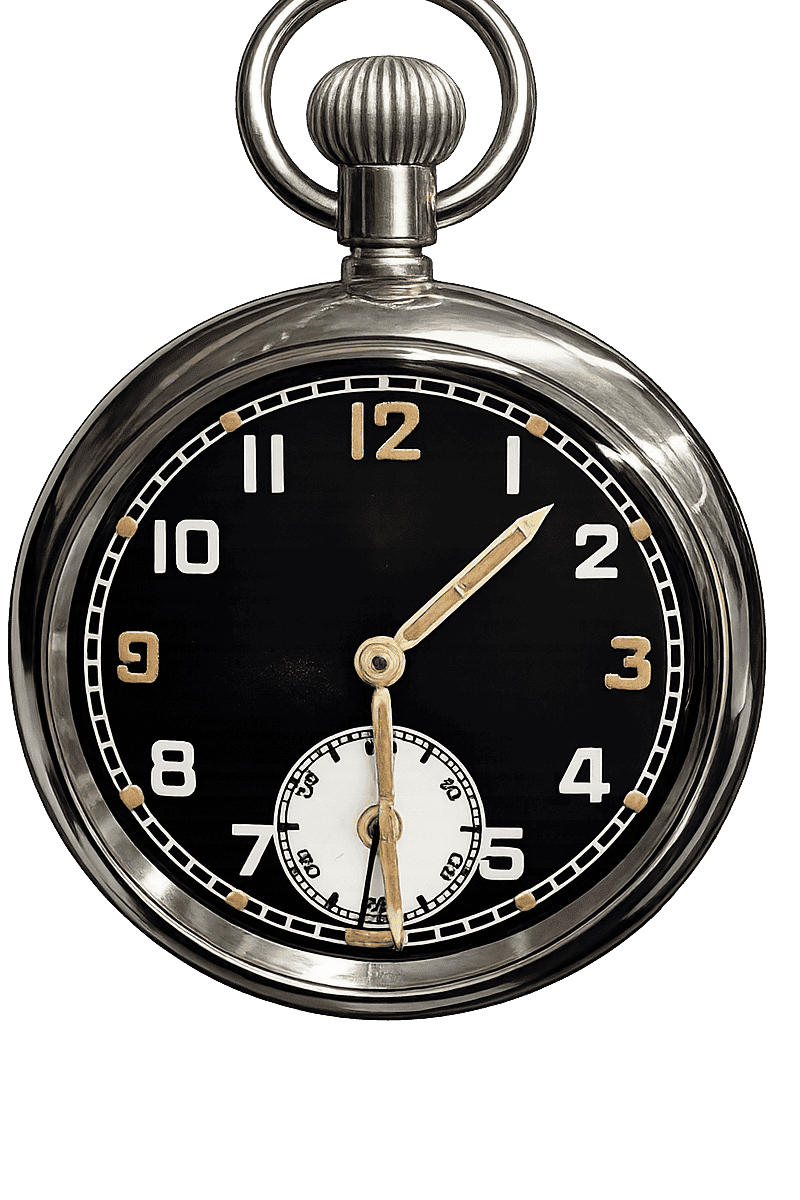
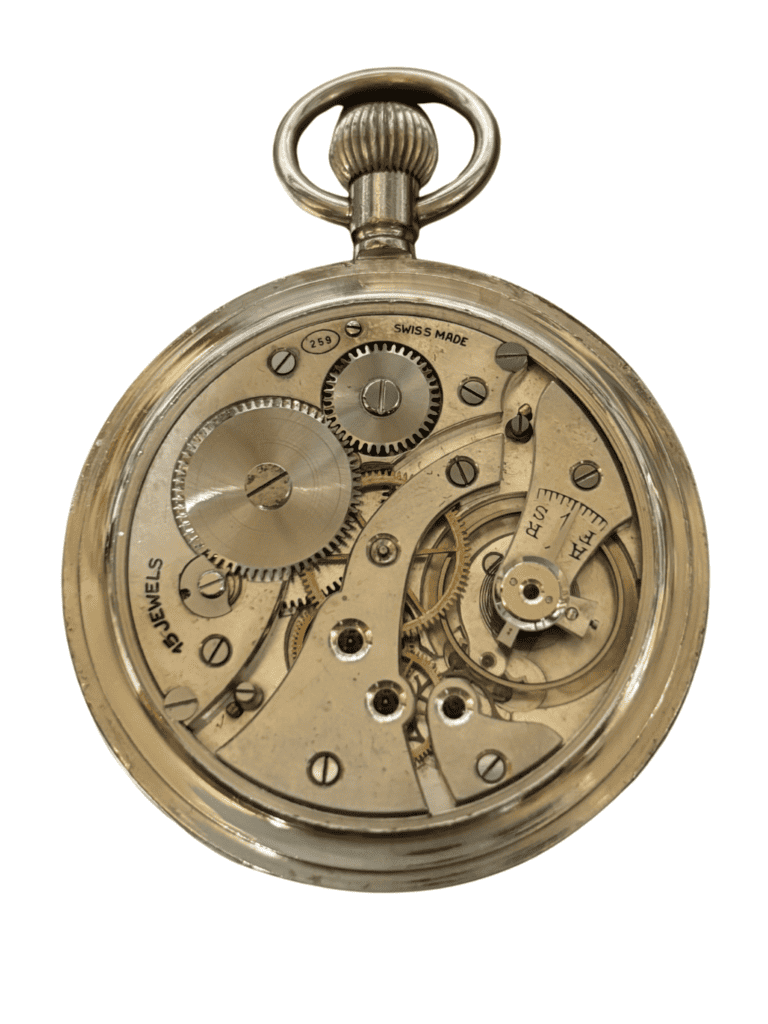
The history of twentieth-century warfare is, in many respects, the history of increasingly precise timekeeping. From the muddy trenches of the First World War to the vast skies over Europe and the Pacific during the Second, victory frequently depended upon the ability of thousands of individuals to act simultaneously. That could only be achieved if everyone shared the same time.
Long before satellite navigation and atomic clocks, the humble mechanical watch became one of the most important pieces of military equipment ever issued.
The First World War: Time Leaves the Pocket
At the outbreak of the First World War in 1914, the wristwatch was still regarded by many gentlemen as something of a novelty. Pocket watches remained the accepted standard for everyday use, particularly among officers. Trench warfare changed everything.
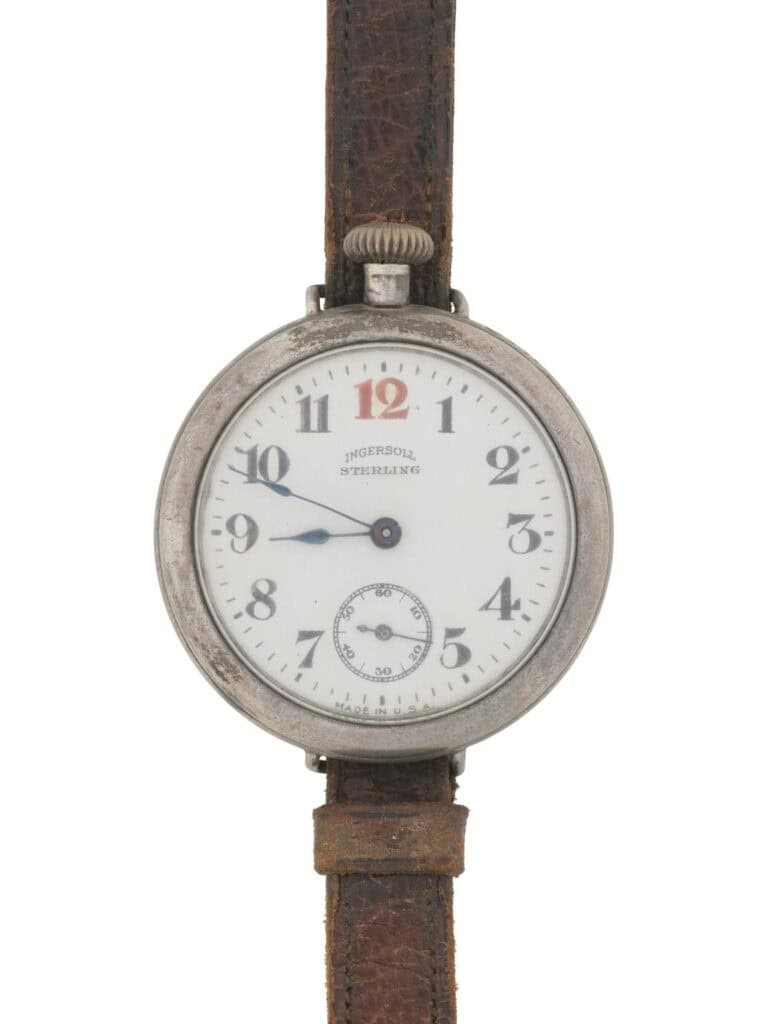
Officers could no longer afford to fumble inside their tunics while directing artillery barrages or leading men over the parapet. A glance at the wrist was faster, safer and infinitely more practical. Leather straps, luminous numerals and protective shrapnel guards transformed elegant civilian watches into purpose-built military instruments.
Perhaps the greatest innovation was not technological but tactical. Military operations increasingly relied upon synchronised attacks. Infantry, artillery and engineers had to work to precisely coordinated timetables. A barrage lifted at 05:17 not because it was approximately dawn, but because every commander’s watch had been synchronised beforehand. Time itself had become a weapon.
Synchronisation Saves Lives
Military planning evolved rapidly during the First World War. Artillery bombardments were calculated to the minute. Railway movements operated to strict schedules. Naval convoys depended upon coordinated manoeuvres, while the newly emerging air services required precise timing for reconnaissance and bombing missions.
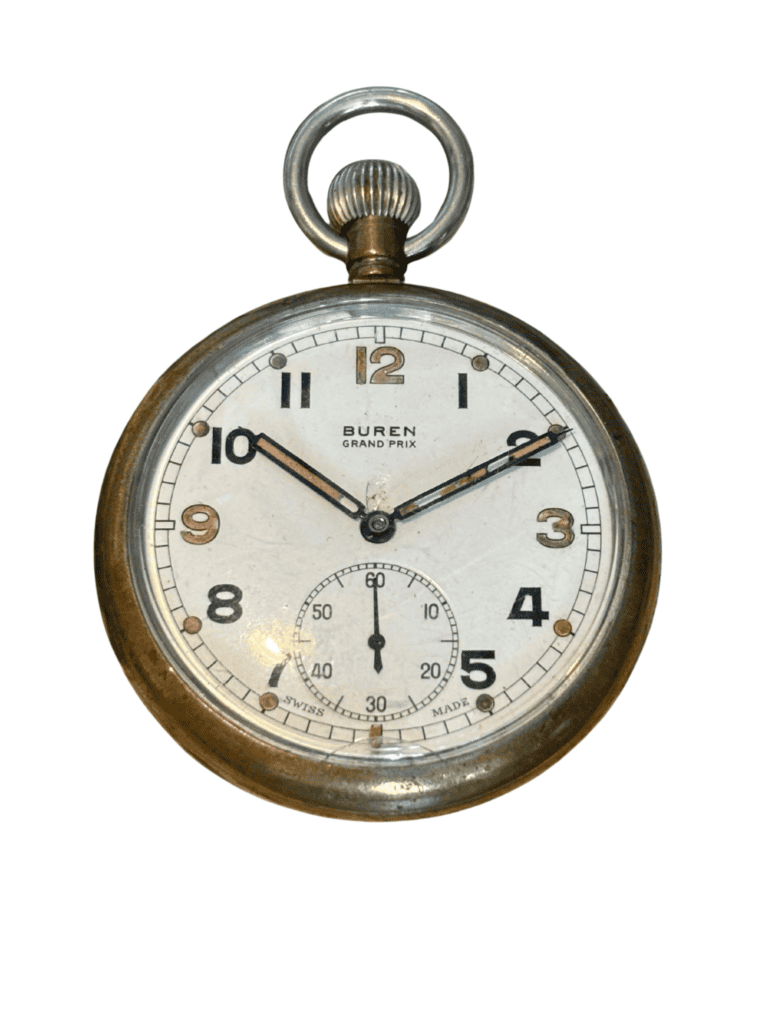
Without reliable watches, confusion rapidly descended into catastrophe. The importance of synchronisation led to rigorous standards of watch inspection and maintenance. Accuracy ceased to be a matter of personal pride; it became an operational necessity. These lessons would profoundly influence military horology during the decades that followed.
Between the Wars: Precision Engineering
The years between the two world wars witnessed remarkable advances in precision watchmaking. Manufacturers such as Hamilton, Longines, Zenith, Omega and Elgin refined movements capable of maintaining exceptional accuracy under demanding conditions. Improvements in balance design, hairsprings, jewel bearings and positional adjustment produced watches that rivalled scientific instruments.
Many developments owed much to the exacting standards established by the railways. American railroad watches had already demonstrated that reliable timekeeping could prevent disaster. Trains travelling in opposite directions depended upon every engineer carrying an exceptionally accurate watch.
Military planners recognised the obvious parallel. If railroads required absolute precision, so too did aircraft travelling hundreds of miles across featureless oceans.
The Second World War: Time Across Continents
By 1939 warfare had become vastly more complex. Aircraft flew through darkness and cloud, naval fleets crossed entire oceans, while bombing raids required dozens or even hundreds of aircraft to arrive over their targets within minutes of one another.
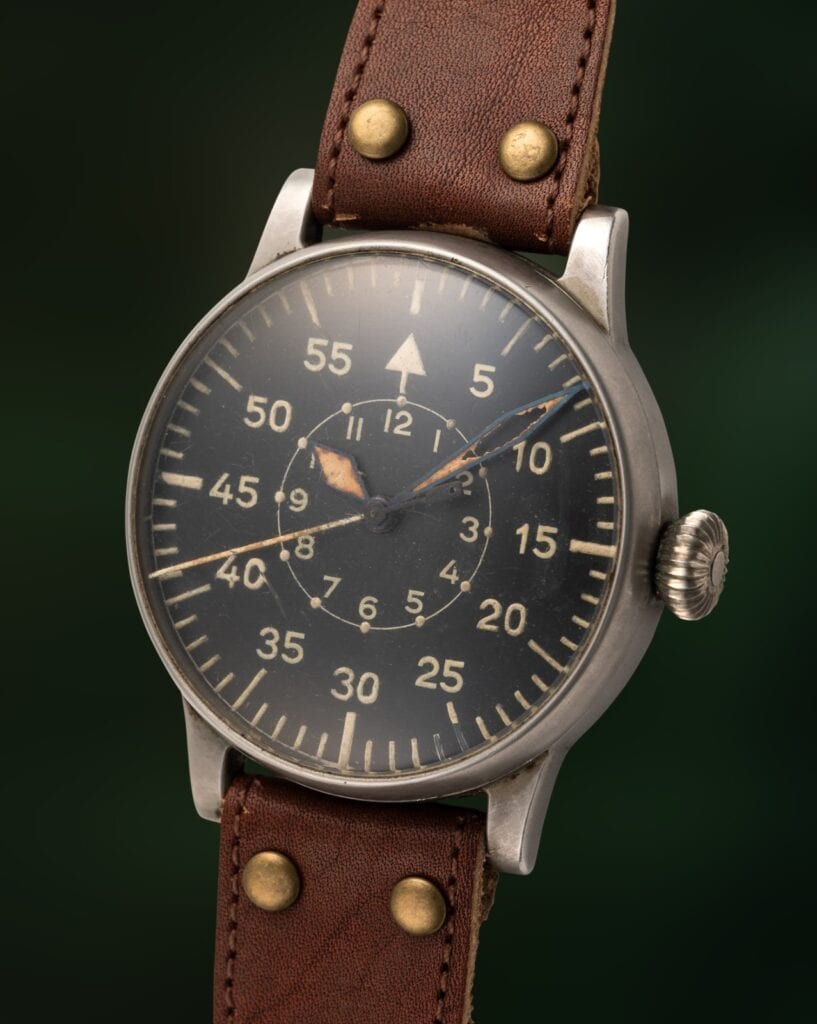
The navigator had become one of the most important members of every aircrew. Before the advent of electronic navigation, determining position relied upon dead reckoning, radio beacons and celestial navigation. Every calculation depended upon one fundamental requirement: knowing the exact time.
An error of only a few seconds could translate into miles of navigational error. Consequently, navigation watches became among the most accurate portable timekeepers ever produced.
A Military Masterpiece
Among these remarkable instruments, none better illustrates the marriage of military necessity and horological excellence than the Hamilton Grade 4992B. Derived from Hamilton’s celebrated 992B railroad movement, the 4992B represented one of the finest mechanical navigation watches ever supplied to the United States military.
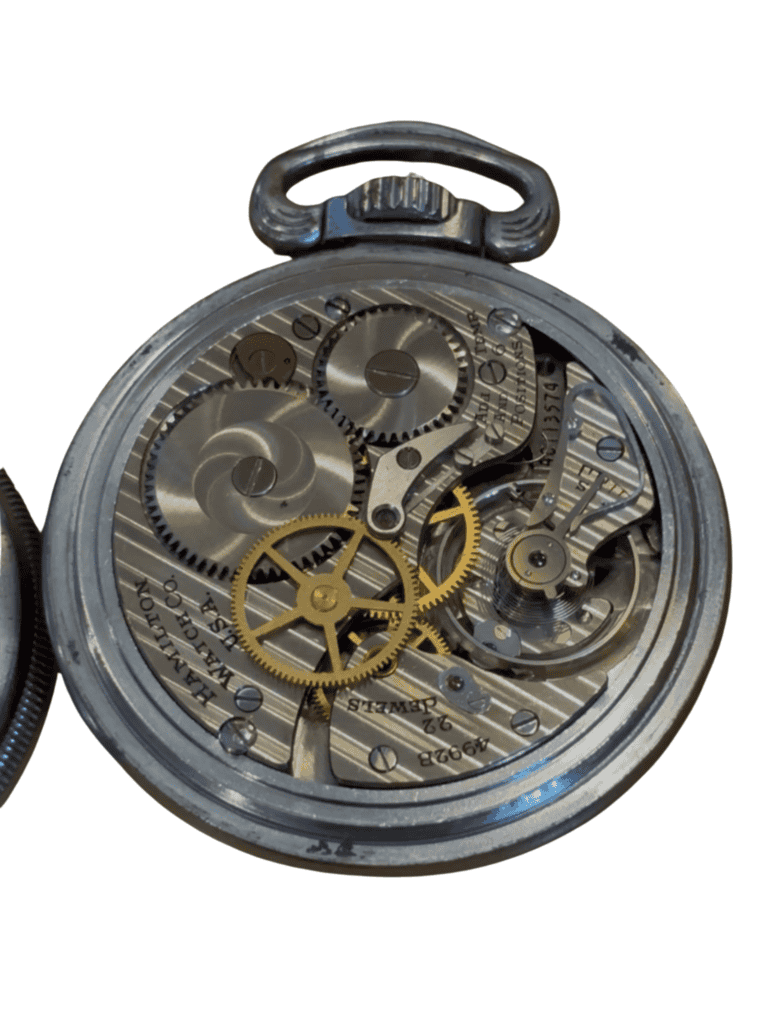
The example illustrated here bears the designation AN-5740-1, identifying it as a military navigation watch supplied under Army-Navy specifications. Its beautifully finished nickel movement contains twenty-two jewels and is adjusted to temperature and six positions, standards normally associated with observatory-grade precision.
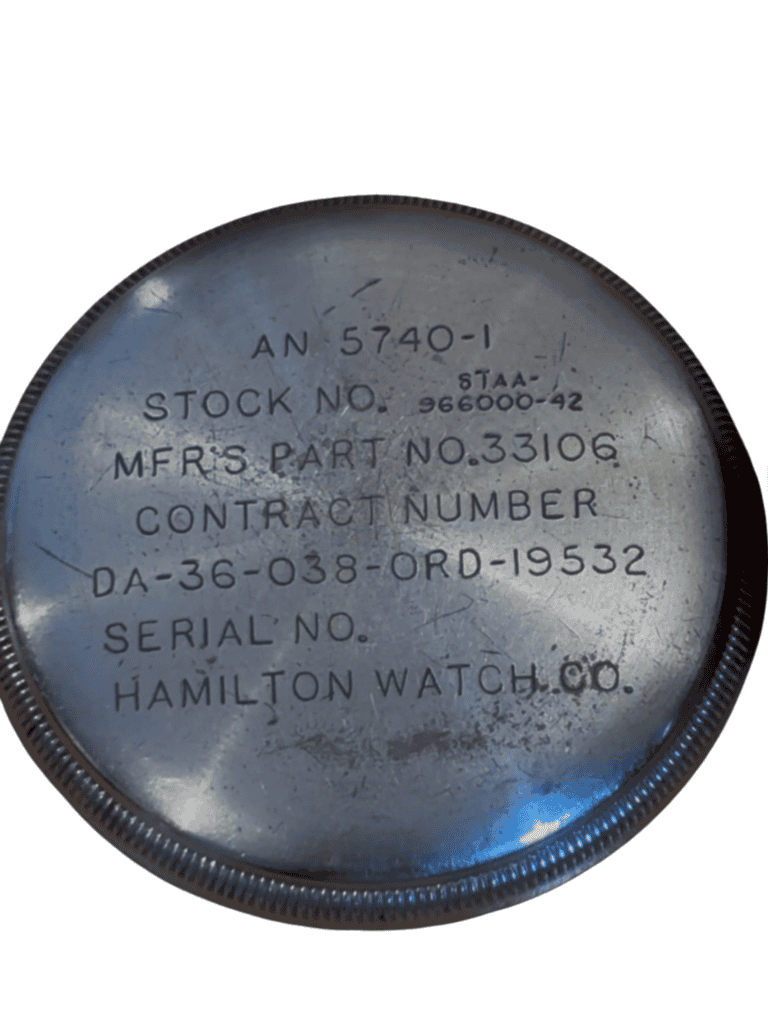
Every component served a purpose. The hacking mechanism allowed navigators to stop the seconds hand while synchronising with an official time signal. The large crown permitted operation while wearing gloves. Most distinctive of all was the twenty-four-hour dial.
Unlike conventional watches, the hour hand completed a single revolution each day. Noon occupied the top of the dial, midnight the bottom. Marked simply G.C.T. (Greenwich Civil Time) the dial eliminated any possibility of confusing morning with evening during long operational flights. By displaying G.C.T unambiguously throughout the day, it eliminated the possibility of AM and PM confusion at a moment when a few seconds’ error, or a simple misreading of the hour, could place an aircraft many miles from its intended course.
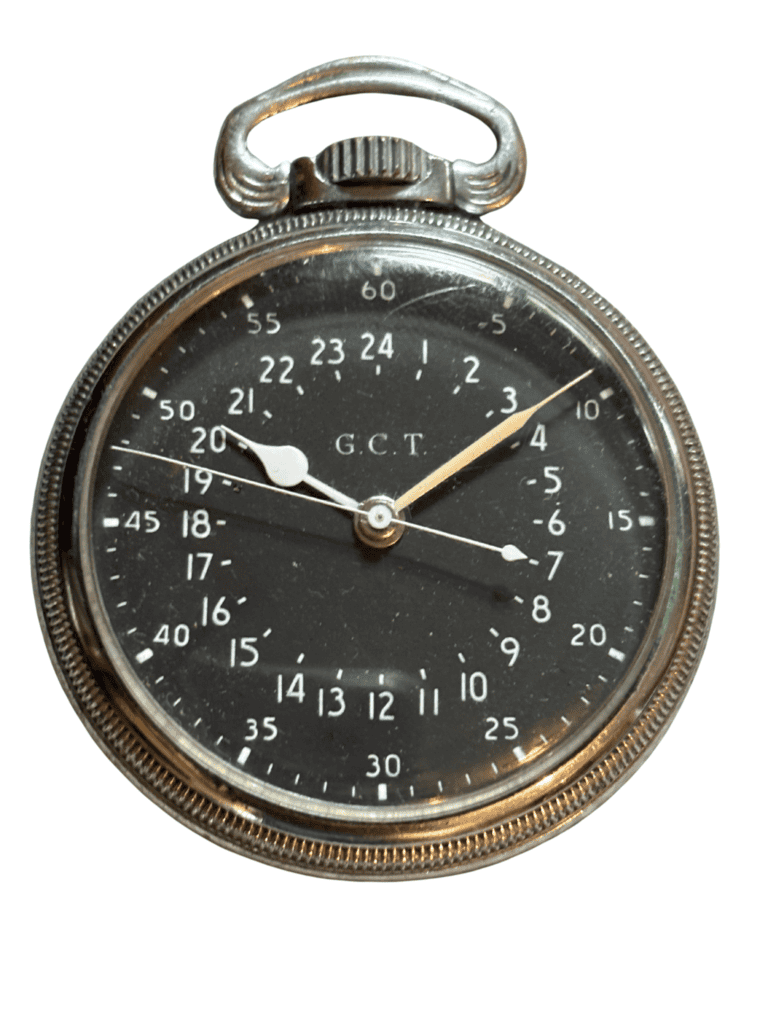
For navigators plotting courses across the Atlantic or Pacific, such clarity was invaluable. Holding the watch today, one appreciates not merely its craftsmanship but its extraordinary responsibility. This was not a gentleman’s accessory. It was a precision instrument upon which lives depended.
Precision Under Pressure
Military watches faced conditions unimaginable in civilian life. Extreme temperatures, vibration, moisture, magnetic fields and violent shock all threatened reliable operation. Manufacturers responded with increasingly sophisticated engineering. Balance springs were refined, lubrication improved and movements adjusted to maintain accuracy regardless of orientation.
The Hamilton 4992B exemplified this philosophy. Its striped bridges, micrometer regulator and immaculate finishing reflect a movement designed not for luxury but for uncompromising performance. It remains one of the finest military pocket watches ever manufactured.
Beyond the Battlefield
Ironically, many military innovations transformed civilian watchmaking after 1945. Water-resistant cases, luminous dials, shock protection and highly accurate movements became everyday expectations rather than specialised military requirements. The watch below was worn by Sir Edmund Hillary during his successful climb to the summit of Mount Everest, May 29th 1953. He reported back to Smiths that the watch had performed very well. This particular watch had been prepared by Smiths with a special lubricant to withstand low temperatures.
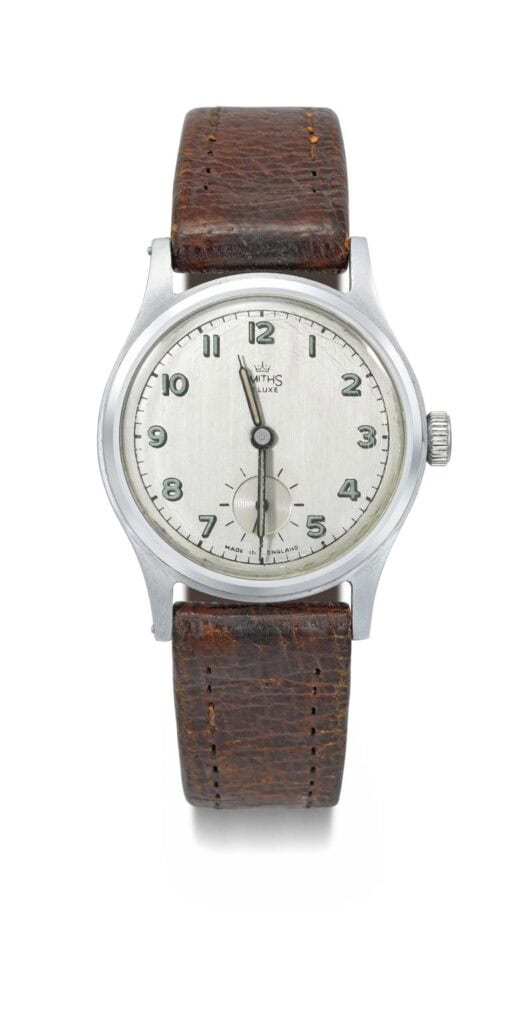
The wristwatch itself owed much of its universal acceptance to lessons learned in the trenches of the First World War. Military necessity had accelerated horological progress by decades.
A Legacy That Endures
Today collectors are understandably drawn to military watches because of their historical associations. Yet their true significance lies elsewhere.
These instruments remind us that precision is not merely an academic pursuit. During two world wars, accurate time underpinned navigation, logistics, communications and coordinated operations on an unprecedented scale.
In an age when our smartphones synchronise automatically with atomic clocks, it is easy to forget that such certainty once depended upon springs, gears and the skill of master watchmakers. The story of military watches is therefore not simply one of conflict.
It is the story of how horology helped shape the modern world, proving that sometimes the most powerful weapon on the battlefield was not carried in the hand, but measured within it.
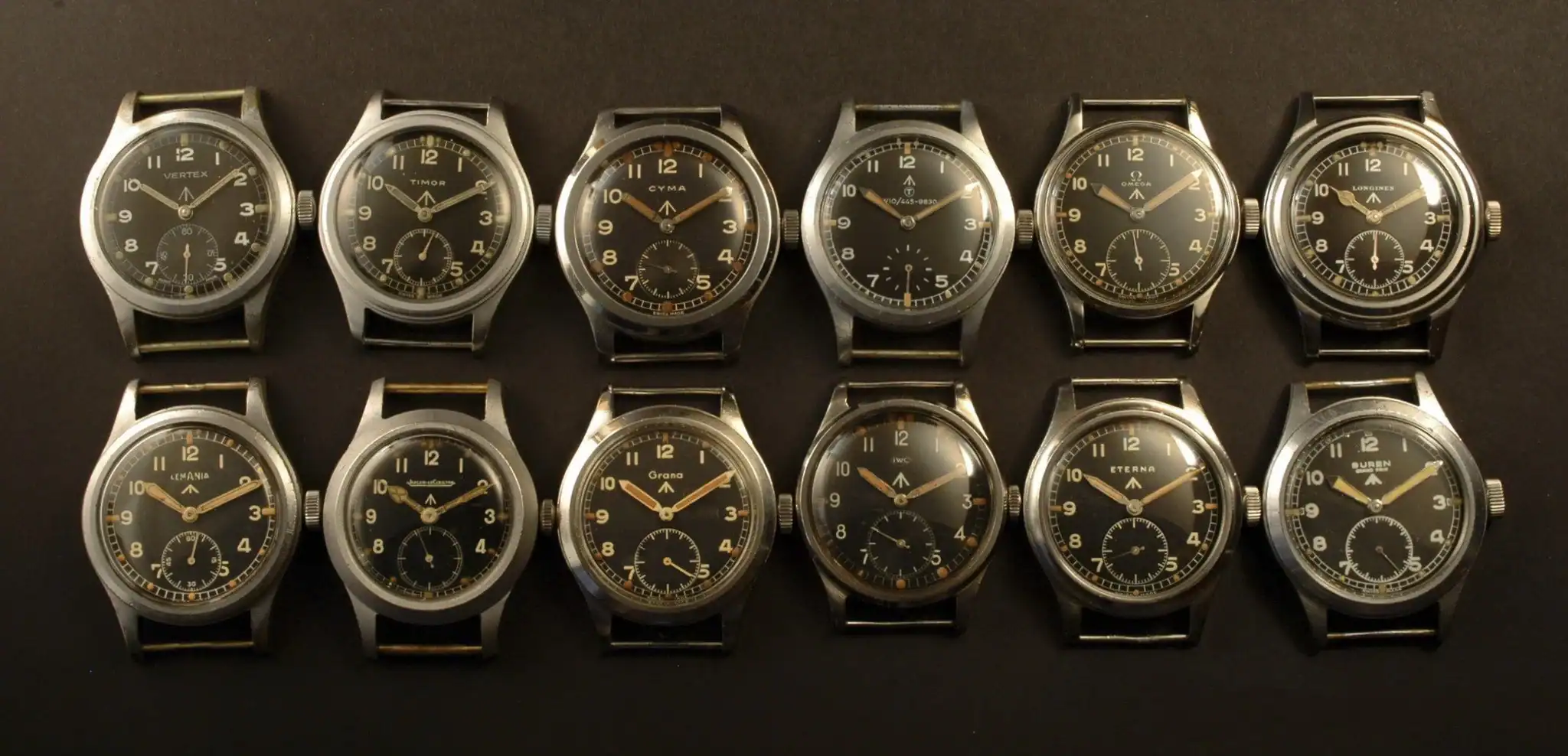
Hero Image: The 12 watches that compose the so-called “Dirty Dozen” (Photo by A Collected Man)