
The Seconds Collector: Where Mechanical Time Becomes Irreversible
How a conversation between father and son inspired artist Vasile Rata’s extraordinary final artistic cycle.
There are countless books, exhibitions and articles devoted to the beauty of mechanical watches. We celebrate their precision, craftsmanship and ingenuity. We admire the intricate choreography of wheels, bridges, jewels and escapements working together to measure time with extraordinary accuracy.
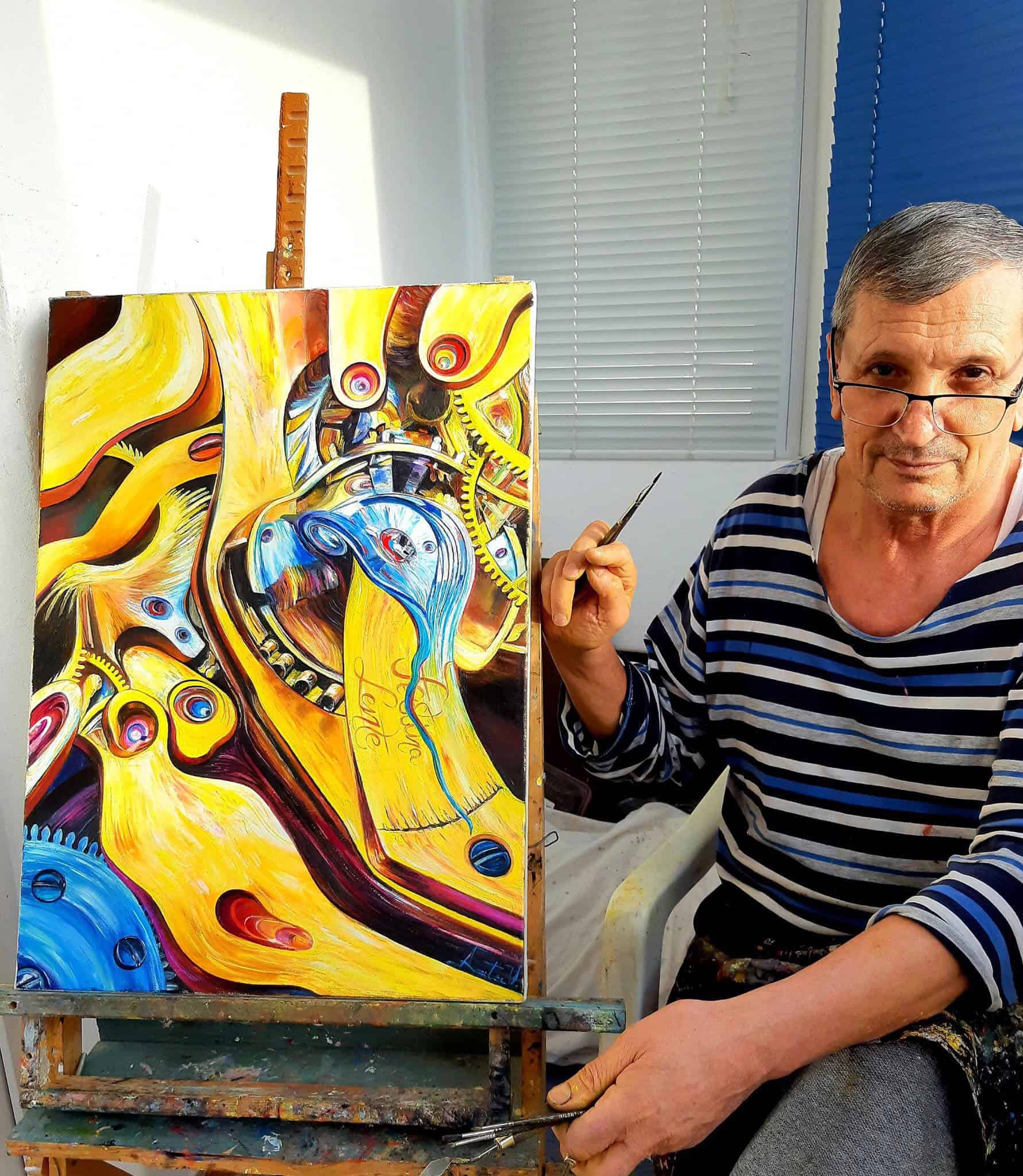
Far rarer, however, are works of art that ask us not how a watch measures time, but how we experience it. That is precisely the question at the heart of The Seconds Collector, a remarkable cycle of six oil paintings by Romanian artist Vasile Rata (1955–2024).
At first glance, they appear to be richly coloured, almost dreamlike interpretations of mechanical watch movements. Look closer and something more profound begins to emerge. These are not abstract paintings inspired by horology, nor straightforward depictions of watch mechanisms. They explore the relationship between mechanical precision, reflection and the irreversibility of time itself.
For collectors who have spent years appreciating the artistry of fine watchmaking, they offer something rare: a new way of seeing the mechanical movement.
A Question That Changed Everything
Like many significant ideas, the project began not in a studio, but in a conversation.
Vasile’s son, Adrian, had acquired a pocket watch whose movement fascinated them both. Rather than asking his father simply to paint the movement, he posed a different question.
A mechanical movement measures time with absolute precision. Yet the image we perceive of that movement, including its reflection, already belongs to a moment that has passed. However brief that interval, the reflected image has travelled through time before it reaches us.
What, Adrian wondered, might happen to that reflection if time itself were allowed to transform it?
Could its form twist, evolve and distort while still preserving the identity of the mechanical movement from which it originated?
That challenge became the foundation of The Seconds Collector series.
Understanding Before Transforming
The originality of the collection lies not simply in its appearance, but in the discipline behind its creation.
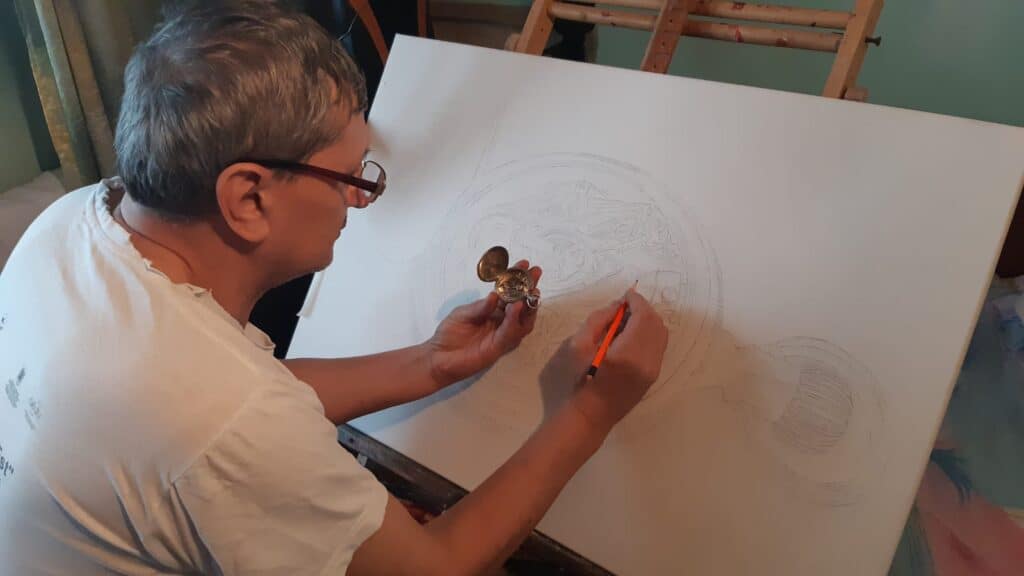
Before Vasile transformed a movement on canvas, he first sought to understand it. His background in technical drawing and a career in aviation gave him an instinctive appreciation of complex mechanical structures.
He studied each movement carefully, its bridges, wheels, balance, jewels and the relationships between every component, not merely as an artist, but as someone capable of understanding how a mechanism functions as an integrated whole.
Only then did imagination take over. The distortions that followed were never arbitrary. However expressive the paintings became, each retained the essential structural identity, the mechanical “DNA”, of the real movement from which it evolved.
That distinction is fundamental. These are not abstract paintings loosely inspired by watches. They are artistic transformations of real mechanical movements.
The Origin: Irreversible
Every collection has a beginning. For The Seconds Collector, it is a single painting entitled Irreversible (below). This originating work presents both a real mechanical movement and its transformed reflection within the same composition. Reality and imagination coexist on the canvas, inviting the viewer to consider the relationship between measured time and experienced time.
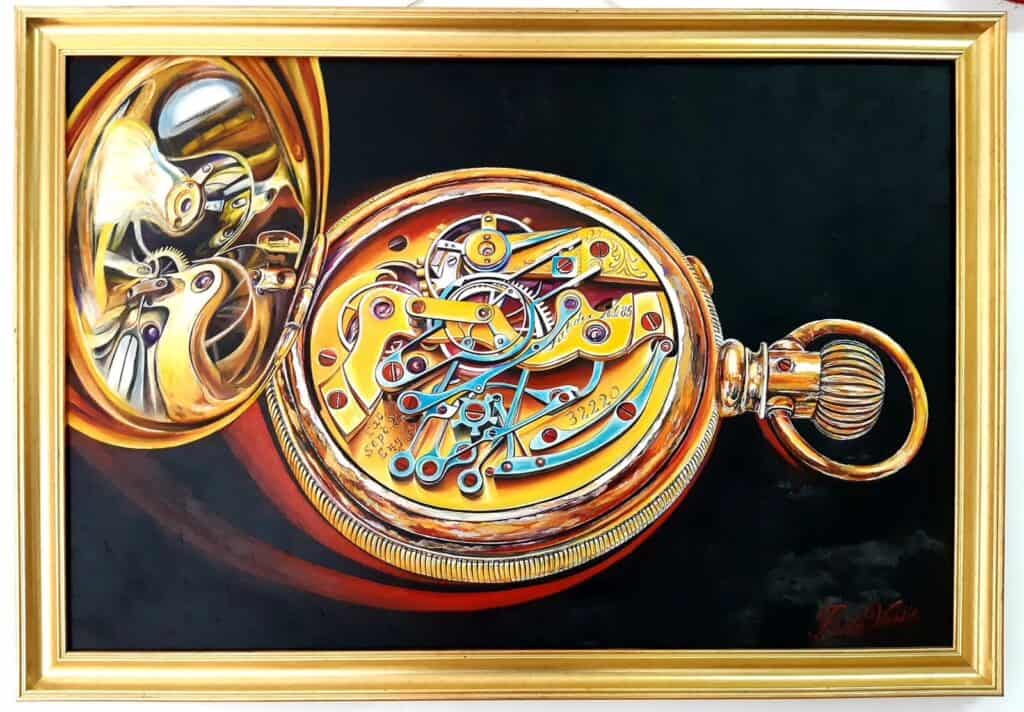
The title captures the central idea beautifully. Once a moment has passed, it cannot be recovered. Time is irreversible.
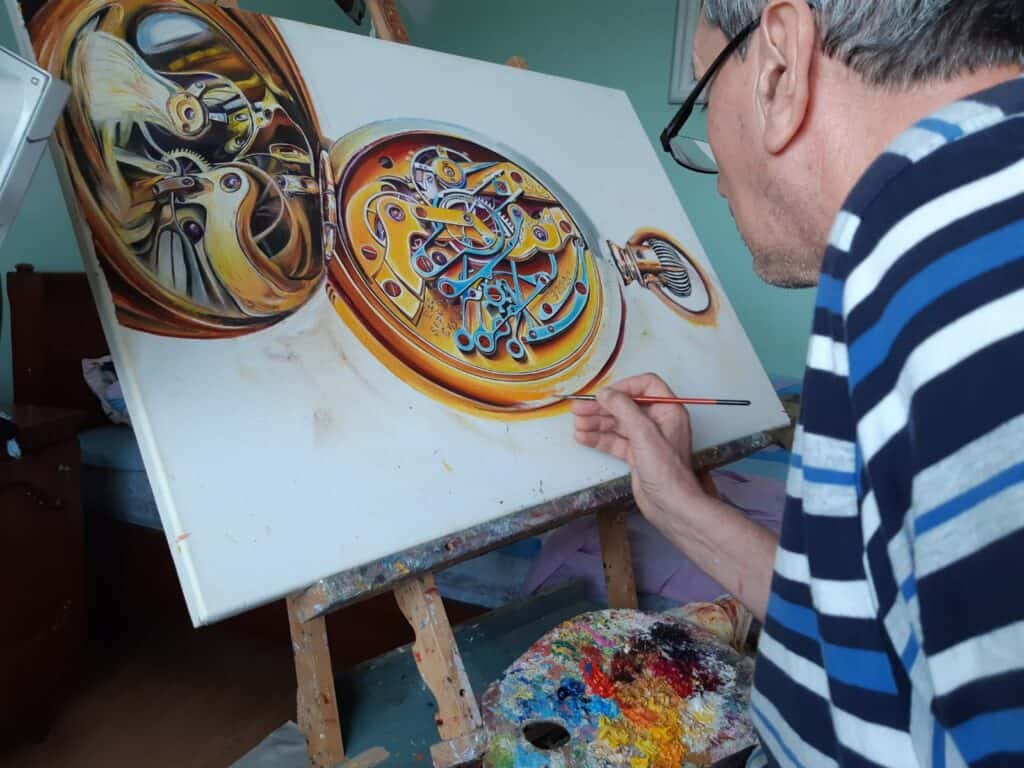
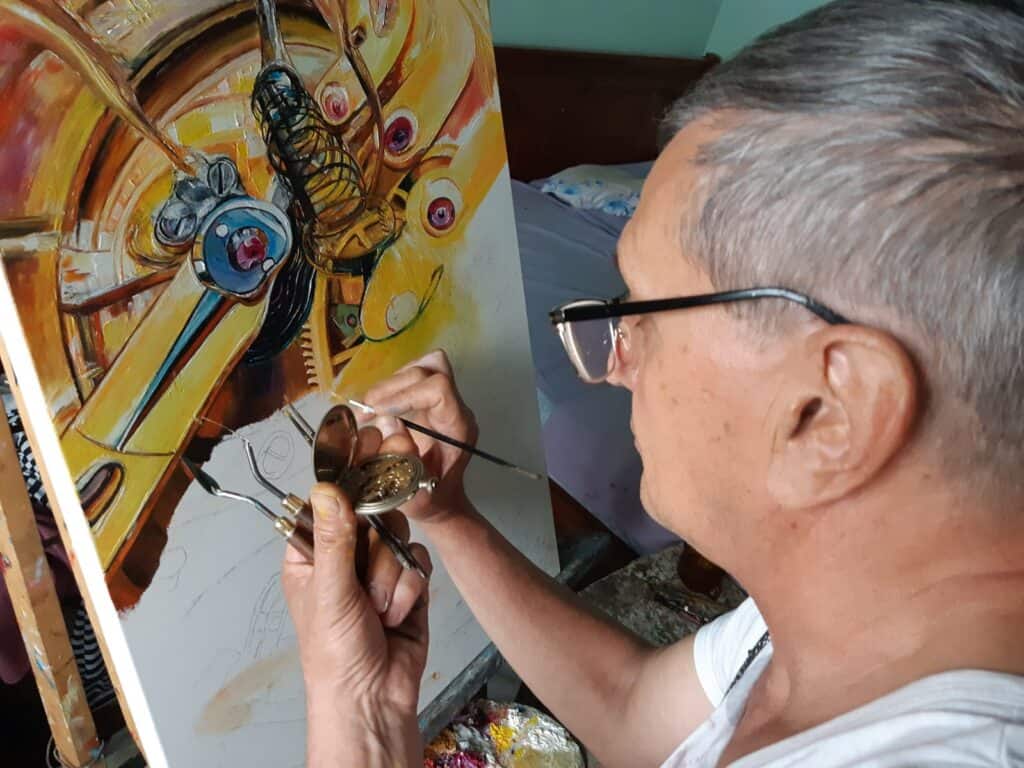
Photographs documenting the painting’s creation reveal the evolution of the work, offering a rare insight into the artist’s process and establishing an important record of the collection’s development.
When One Painting Became Six
The true brilliance of the project becomes apparent in the next stage of its evolution.
Rather than creating another unrelated painting, Vasile isolated the transformed reflection already contained within Irreversible and developed it into an independent work.
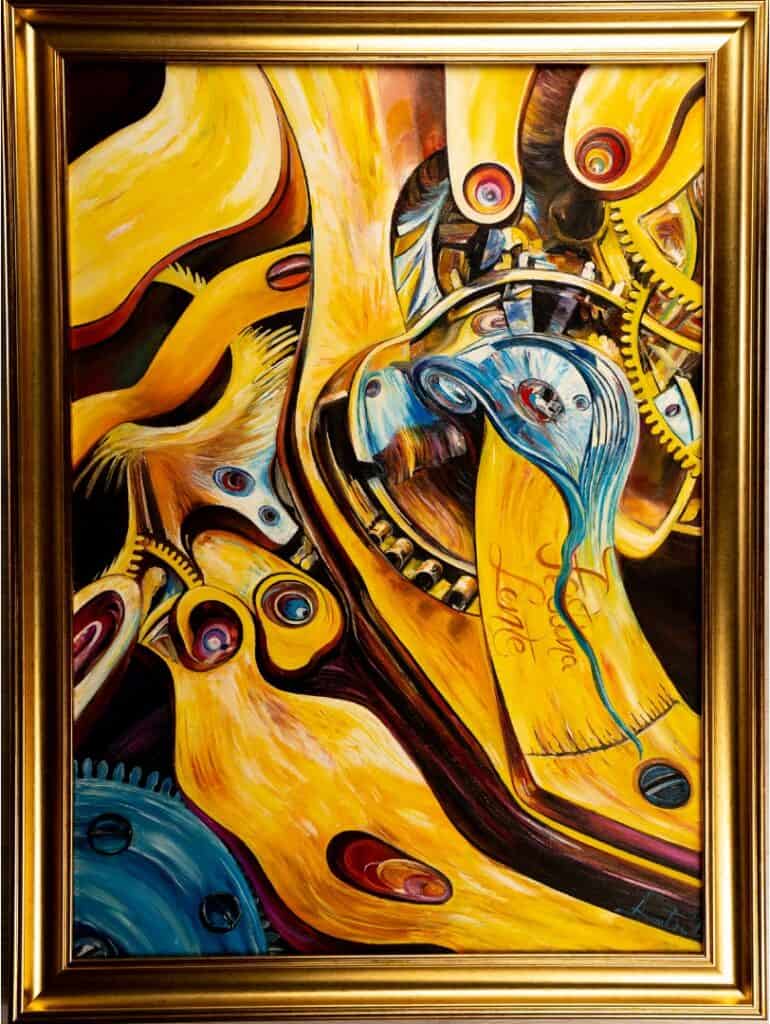
This became the first Reflection (below). What had previously existed as one element within a larger composition now became a painting in its own right, whilst remaining unmistakably connected to the original movement from which it emerged.
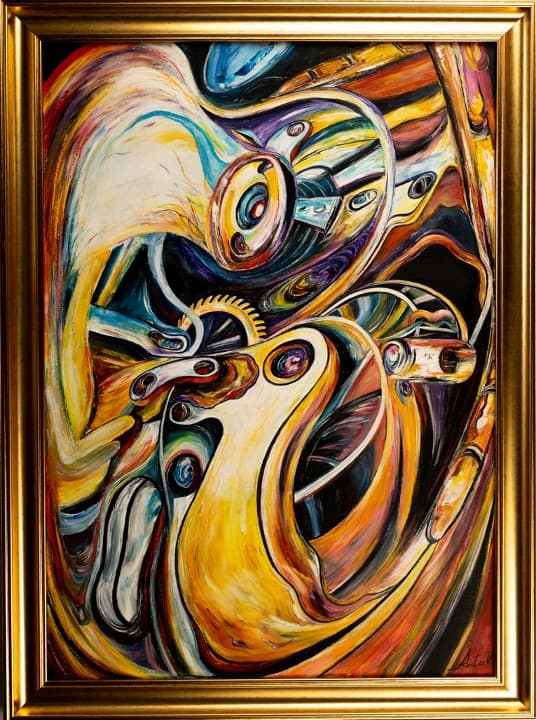
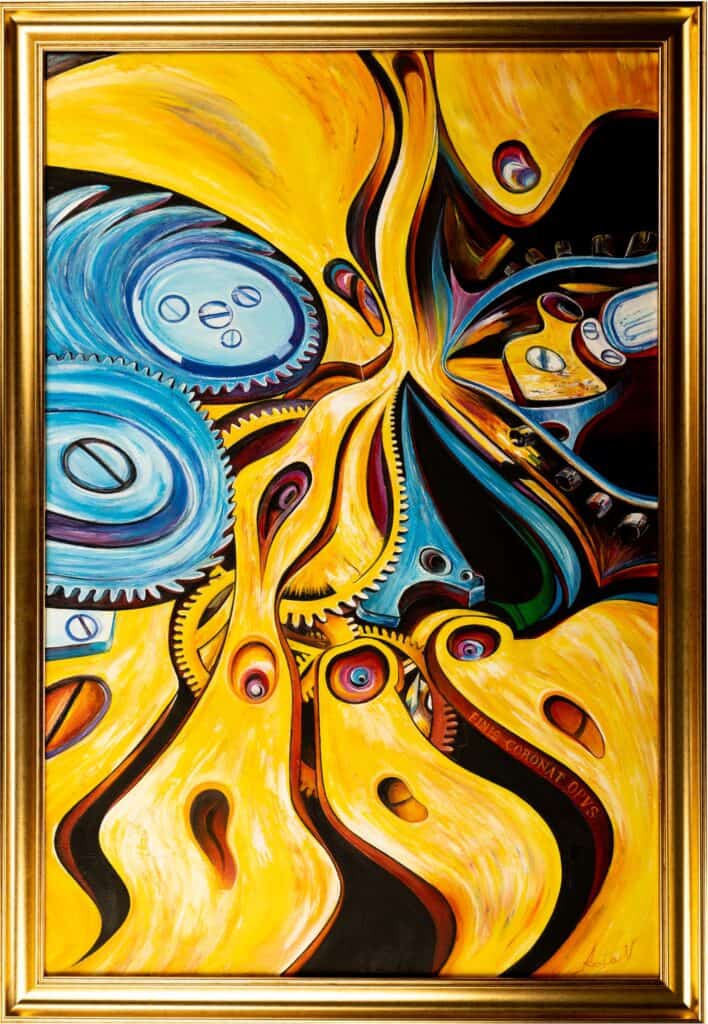
The remaining four Reflections continued the same principle. Each began with a different real pocket-watch movement. Each preserved the essential structural relationships of that movement. Each transformed those relationships through colour, movement and imagination without abandoning their mechanical identity. Together, the six paintings form a coherent artistic genealogy.
Irreversible is the originating work. The first Reflection grows directly from it. The subsequent four Reflections extend the same concept through four further mechanical movements. This is not simply a group of related paintings. It is a complete artistic cycle.
Precision Meets Imagination
One of the most compelling aspects of The Seconds Collector is the balance between technical understanding and artistic freedom. Without an appreciation of mechanical architecture, the paintings could easily have become decorative abstractions.
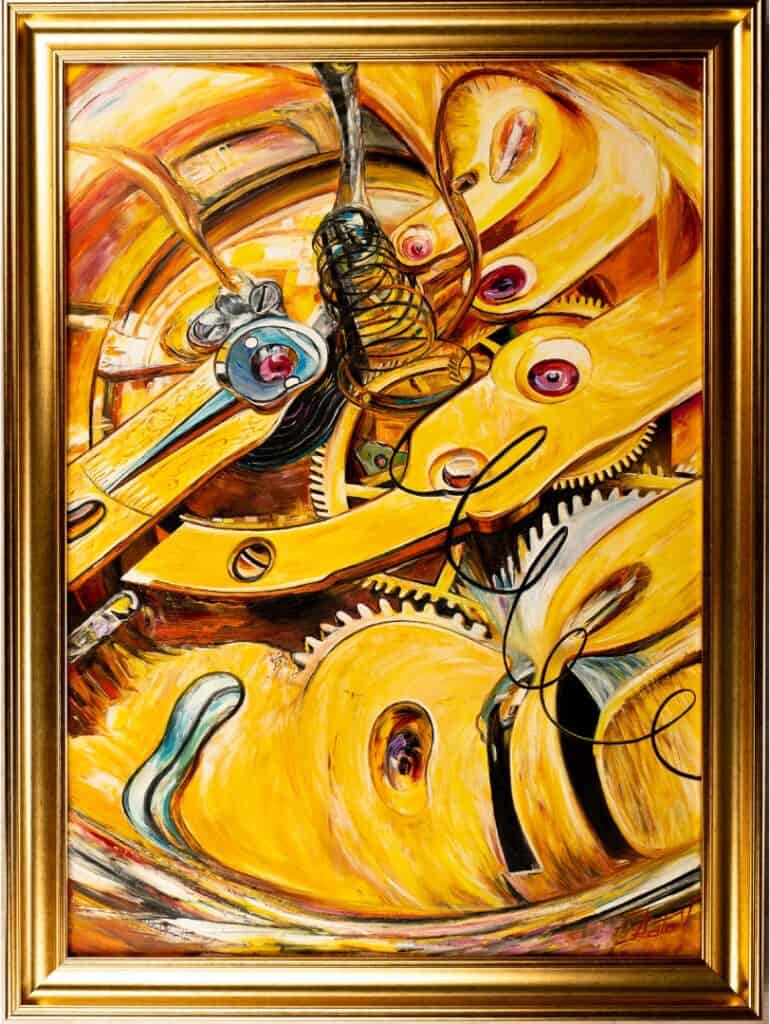
Instead, Vasile achieved something far more subtle. The recognisable structure of each movement survives its transformation. Collectors familiar with mechanical watchmaking may find themselves recognising bridges, wheels and balances emerging from the flowing compositions, much as one gradually discovers new details within the movement of a finely finished watch.
The paintings reward careful observation. Like exceptional watches themselves, they reveal more over time.
A Documented Creative Journey
In an era when provenance has become increasingly important, The Seconds Collector benefits from an unusually rich documentary record.
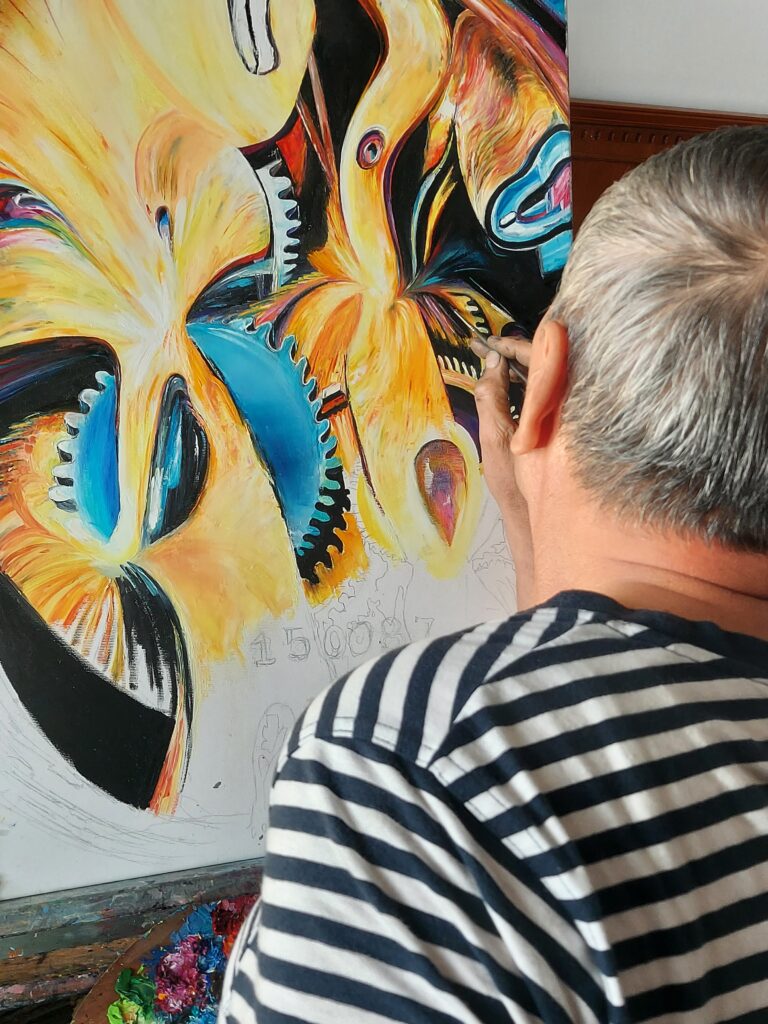
Photographs and video footage record Vasile working on the paintings, documenting their evolution from first brushstrokes to completed works. The public history of the cycle is equally significant.
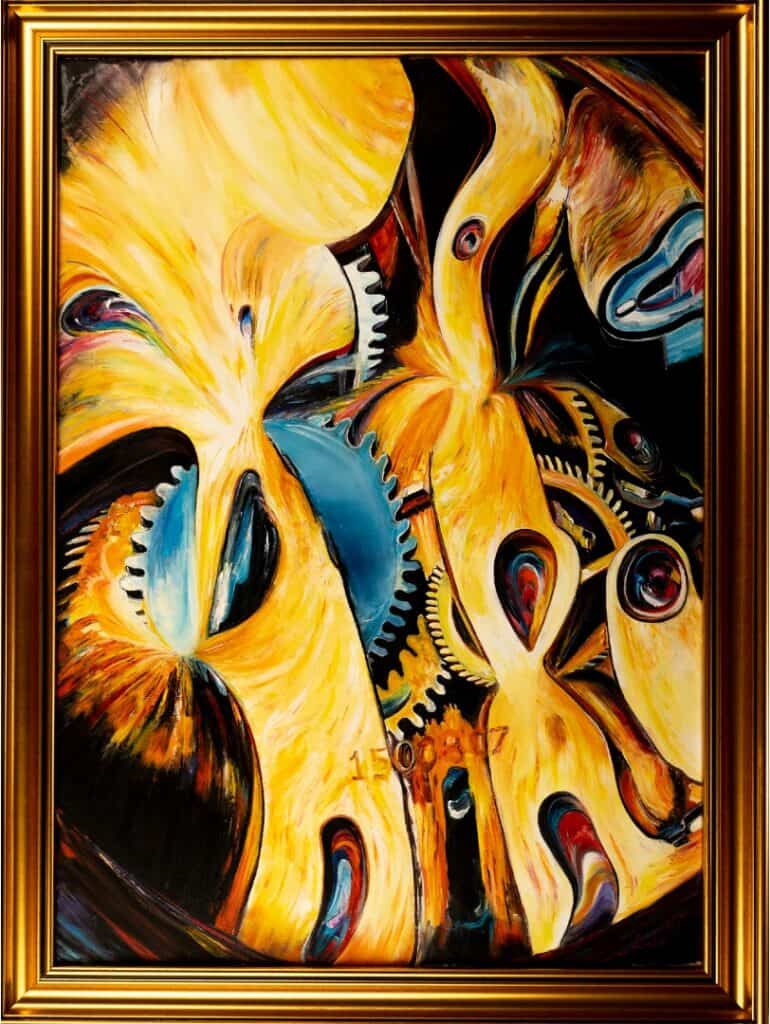
Irreversible was first presented publicly at the Constanța County Library in June 2019 (below). Two Reflections were subsequently exhibited in 2022.
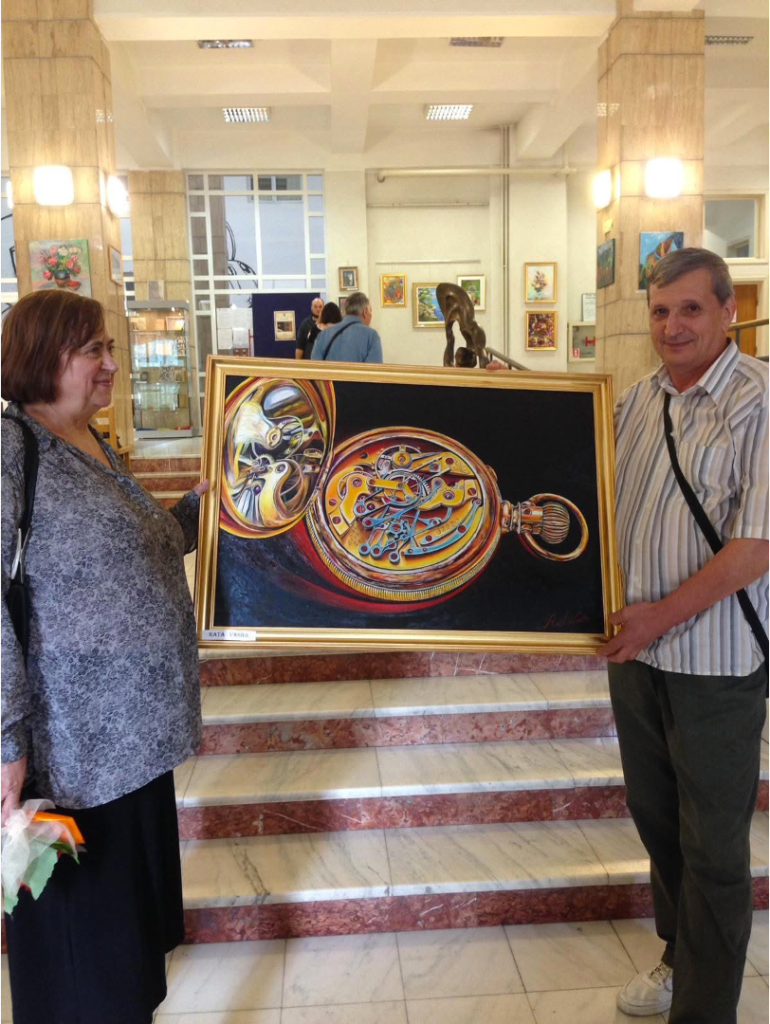
Following Vasile’s untimely death on 8th March 2024, five works from the cycle were presented in memoriam at Time to Watches in Geneva, introducing the collection to an international horological audience during one of the industry’s most important weeks.
These milestones do more than record exhibition history. They establish a clear chronology for the development of the project and reinforce its authenticity.
A Final Artistic Statement
Created over several years and completed in May 2022, The Seconds Collector would become Vasile Rata’s final completed artistic cycle.
The concept, the visual language and the transformation of mechanical reflections had already been fully realised before his health deteriorated. Seen in that light, the collection stands as the culmination of years of artistic discipline, technical understanding and imaginative exploration.
A Closed Cycle
There are six paintings. No more can ever be added. That completeness is central to the integrity of the collection. Each Reflection originates from a real mechanical movement.
Each contributes to the same conceptual journey. Together they form a finished and indivisible body of work.
Rather than repeatedly claiming uniqueness, the paintings simply invite viewers to consider their originality for themselves.
To date, no directly comparable horological cycle has been identified in which the transformed reflections of individual mechanical movements preserve the structural identity of their real-world sources while forming a complete conceptual sequence.
That, perhaps, is what makes The Seconds Collector so compelling.
Beyond Horology
At MrWatchMaster, we spend much of our time celebrating remarkable watches and the people who create them. Occasionally, however, we encounter something that reminds us why watches matter in the first place.
Not simply because they measure time. But because they help us understand our relationship with it.

During our conversations, Adrian shared a thought that has remained with me ever since:
“I often think that when a collector already owns almost everything they desire, what is left to collect?” Adrian Rata
It is a question worth reflecting upon. For some, the answer may indeed be another extraordinary watch. For others, it may be something altogether different: a work of art that captures not merely the mechanics of time, but its mystery, its irreversibility and its enduring power to inspire.
Perhaps that is the true achievement of The Seconds Collector. It does not simply depict horology.
It invites us to see it differently.
Editor’s Note
MrWatchMaster would like to thank Adrian Rata for his assistance in documenting the chronology, creative development and provenance of The Seconds Collector. His insights have helped ensure that the story presented here accurately reflects the conception and evolution of his father’s final artistic cycle.
About the Artist
Vasile Rata was born on 24 June 1955 in Cosmesti, Galati County, Romania. In 1977 he completed his training at the Military School in Medias and subsequently pursued a professional career in aviation. A decisive biographical turning point came in July 1987, when he was involved in a helicopter accident near Constanta. He was hospitalized in Bucharest and underwent a prolonged period of recovery. After this episode, painting became a much more serious and sustained part of his life.
Largely self-taught as a painter, Vasile worked predominantly in oil on canvas. His aviation background and his later commitment to painting belonged to two very different disciplines: one grounded in technical structure and mechanical precision, the other in observation, imagination and pictorial transformation.
He was also a collector of watches. This personal familiarity with mechanical timepieces is directly relevant to The Seconds Collector: the movements that became sources for the paintings were real mechanisms whose structural identities Vasile studied before transforming them pictorially.
He was active within the artistic community of Constanta and associated with Artisti Dobrogeni and Careul Artelor Amfora. Vasile Rata died on 8th March 2024.