
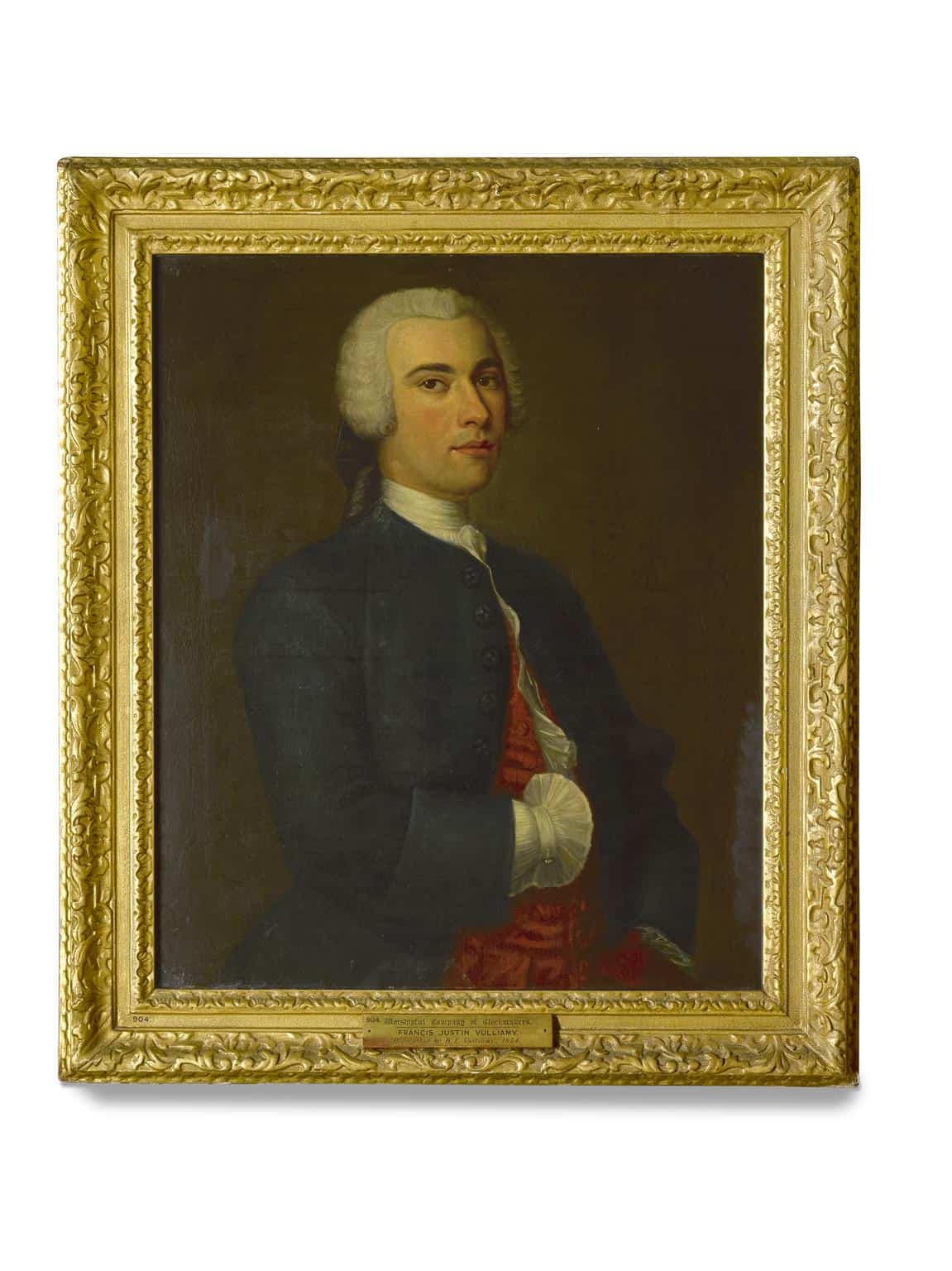
The Greatest Horologists Of Their Time: Justin Vulliamy (1712–1797)
In this occasional series, we explore the life and achievements of the greatest and most respected horologists of their time. This feature focuses on François-Justin Vulliamy, a Swiss-born watchmaker who crossed the Channel in search of horological knowledge and went on to establish one of the most celebrated clockmaking dynasties in British history.
Born in the Pays de Vaud, Switzerland, in 1712, Justin Vulliamy arrived in London around 1730, travelling via Paris. At a time when London was emerging as one of the world’s great centres of precision watchmaking, the young Swiss watchmaker was drawn to the technical innovations being developed by Britain’s finest makers. His particular interest was the cylinder escapement associated with George Graham, one of the defining advances in portable timekeeping of the period.
His arrival in London would prove transformative not only for Vulliamy himself, but for British horology. Within little more than a decade, he had become associated with Benjamin Gray, one of London’s most respected watchmakers and Watchmaker in Ordinary to King George II. In 1743, Vulliamy entered into partnership with Gray, establishing the foundation of a relationship that would ultimately lead to three generations of Vulliamy watch and clockmakers.
From Switzerland To Pall Mall
The partnership between Gray and Vulliamy was more than a commercial arrangement. In 1746, Justin married Gray’s daughter, Mary, bringing together two families and two traditions of British and Continental horology.
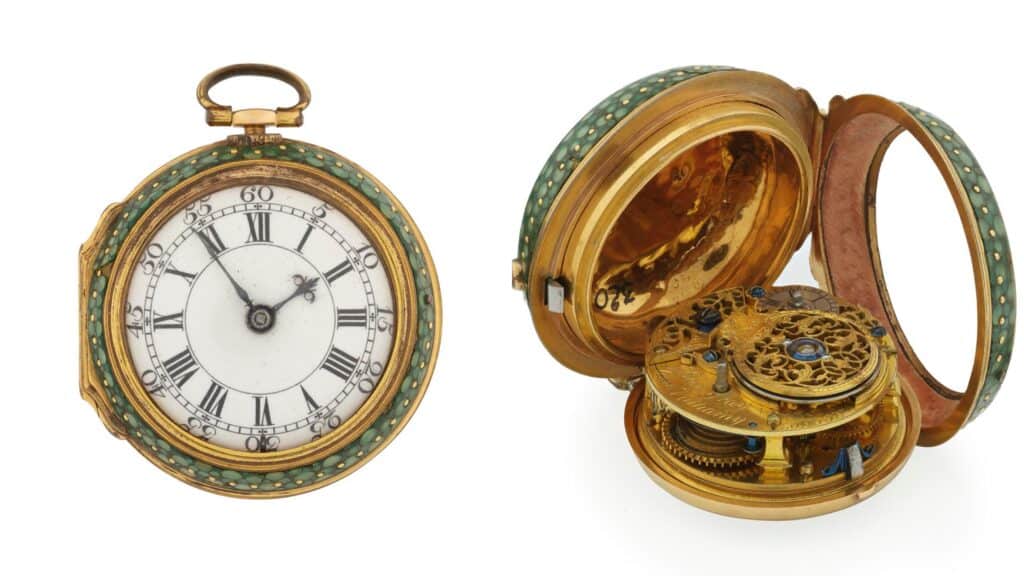
The firm eventually established itself in Pall Mall, an address that would become synonymous with the Vulliamy name. By 1752, Gray had moved his business there, and following his death in 1764, Justin took full control of the firm. The Pall Mall premises would remain at the centre of the Vulliamy business for generations.
This was a particularly important period in English horology. The eighteenth century witnessed extraordinary advances in precision, while London’s makers were responding to growing demand for watches and clocks from royalty, aristocracy, scientists, merchants and an increasingly affluent public. Justin Vulliamy was perfectly positioned to take advantage of this changing world.
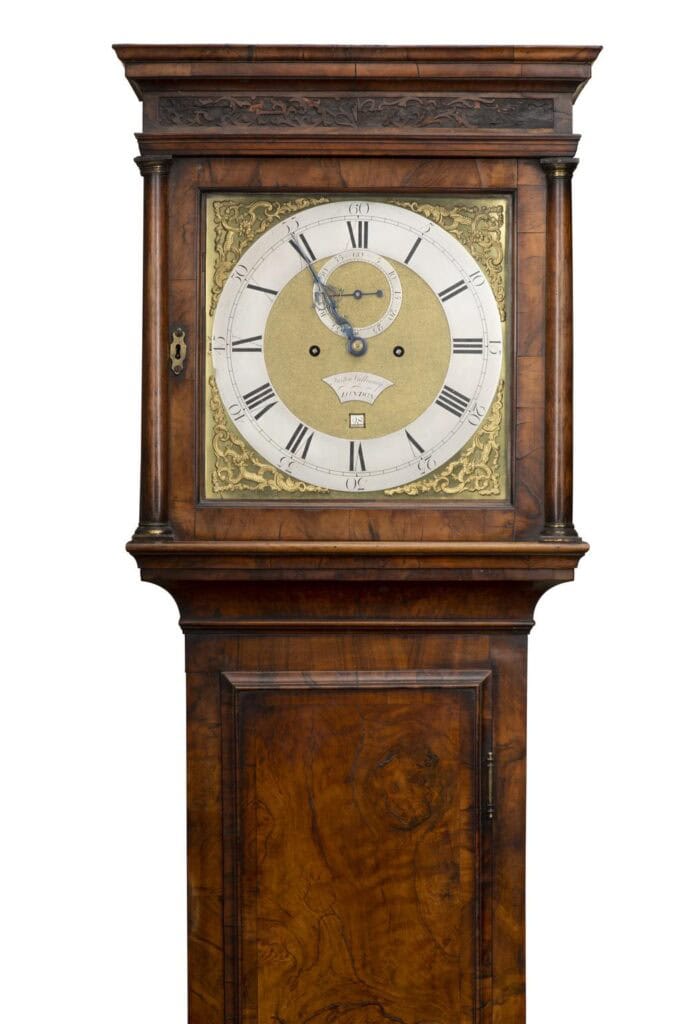
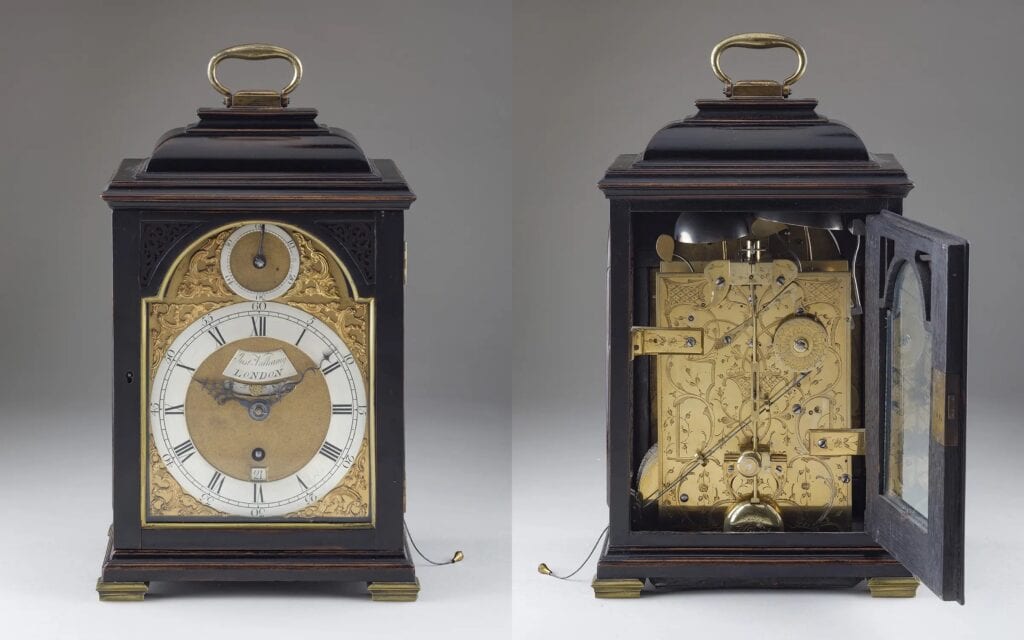
His clocks combined the technical principles of English watchmaking with a Continental sensibility for refinement. Surviving examples demonstrate the breadth of his work, from longcase clocks and elegant bracket clocks to highly finished portable watches.
A longcase clock dating from around 1750 (above), now in the Clockmakers’ Museum collection (below), provides a particularly revealing example. Its walnut-veneered case contains an eight-day movement with an anchor escapement and rack striking, while the brass dial incorporates subsidiary seconds and a date aperture. Signed ‘Justin Vulliamy, London’, it demonstrates the balance between precision, practicality and elegance that became characteristic of his work.
A Master Of The Portable Watch
Although the Vulliamy name would become particularly associated with fine clocks, Justin was also an accomplished watchmaker.
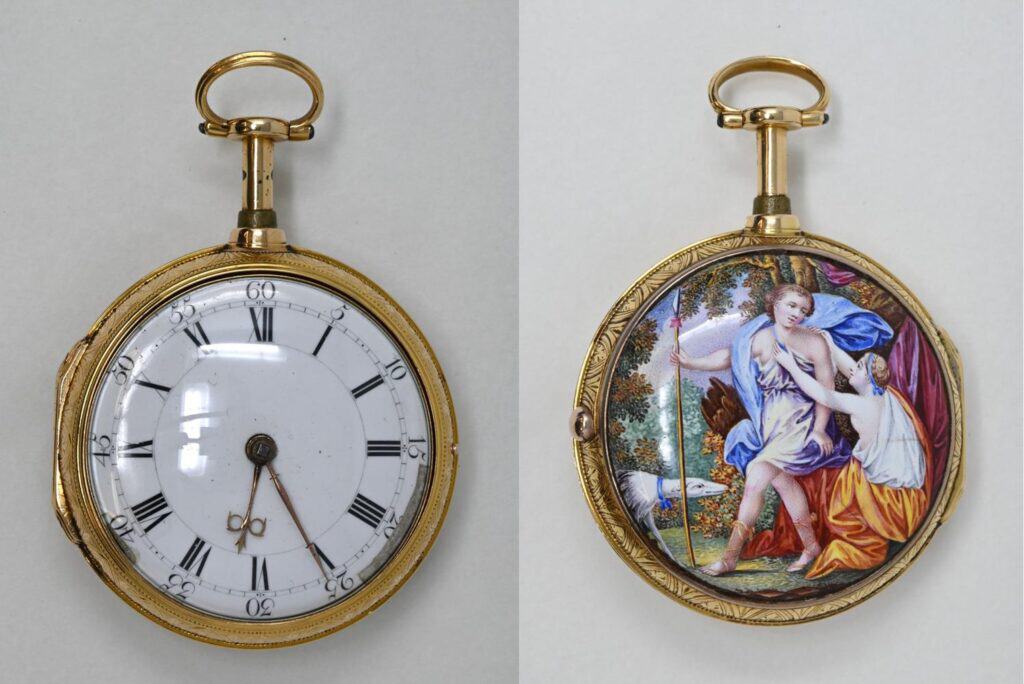
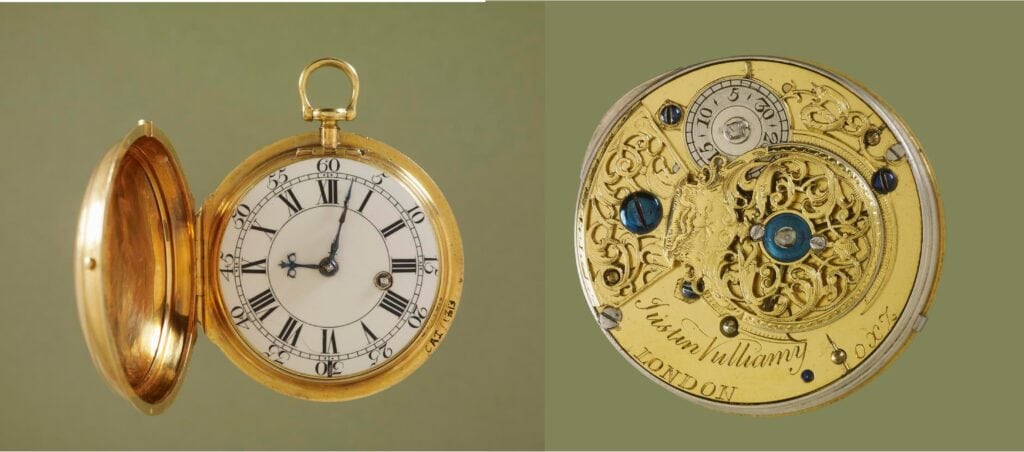
His surviving watches reveal a maker comfortable with the increasingly sophisticated mechanisms of eighteenth-century portable timekeeping. Repeating watches, enamelled cases and cylinder escapements all feature within his surviving output.
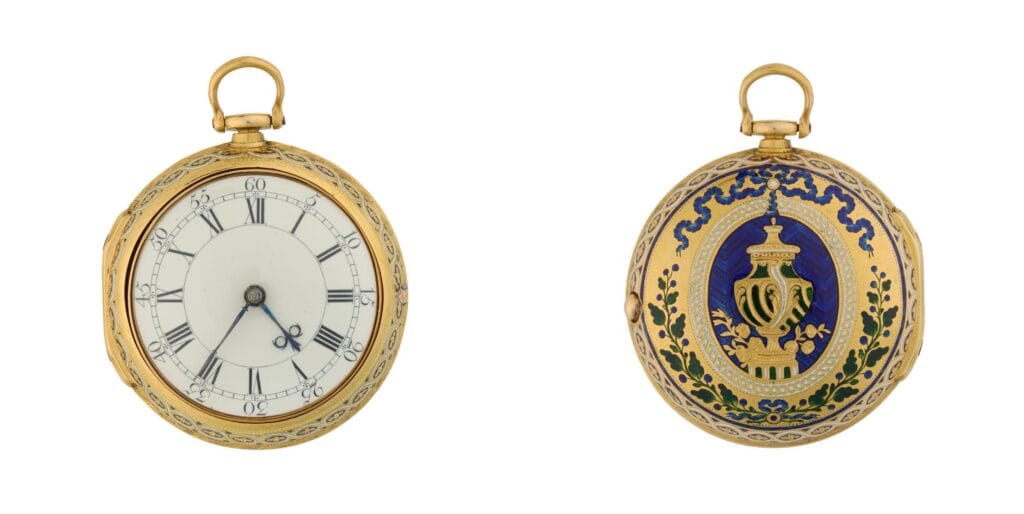
One particularly fine example is a gold and enamel pair-cased watch made in London in 1775 (above). Its outer gold case is decorated with an urn against a blue enamel ground, while the movement, signed ‘Justin Vulliamy London’, demonstrates the quality of his craftsmanship. The movement has a lever escapement, believed to have been converted from an earlier verge escapement, together with a diamond end-stone.
Perhaps even more revealing is the relationship between Vulliamy’s work and the Royal Household. Following George II’s death, the accession of George III brought a monarch with an unusually strong personal interest in science, mechanics and horology. Justin maintained close connections with the new Royal Household and produced watches associated with the King and his circle.
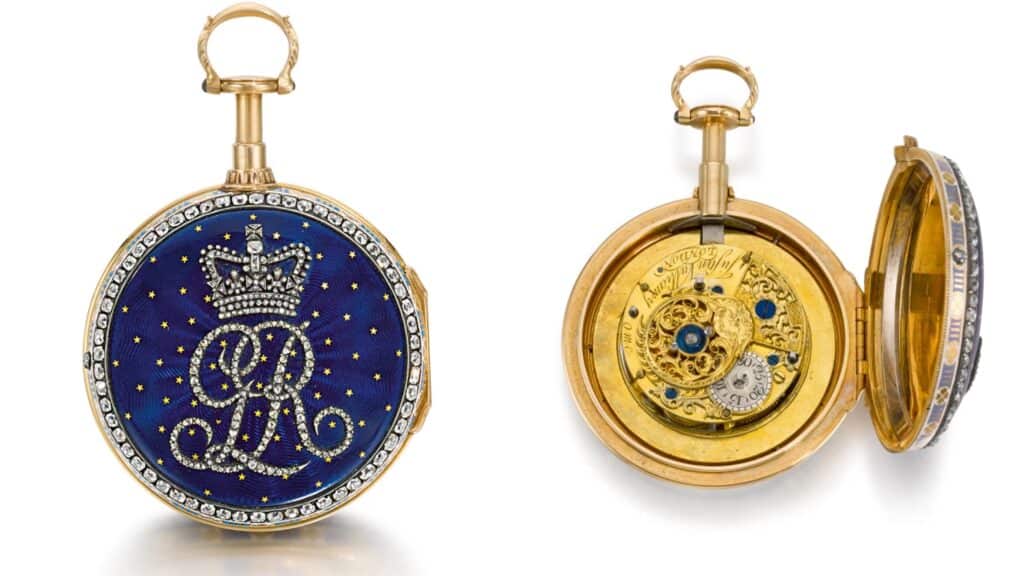
Among the most spectacular are the gold, enamel and diamond-set repeating watches bearing the crowned cypher of George III. Surviving examples in the Royal Collection and elsewhere demonstrate not simply the quality of Vulliamy’s work, but the esteem in which his watches were held. Such pieces could serve as royal gifts to friends and members of the Court.
A Royal Connection
Justin Vulliamy’s relationship with the Royal Household requires some clarification. Benjamin Gray had been appointed Watchmaker in Ordinary to George II in 1742, and the royal connection continued through the Gray and Vulliamy partnership. When Gray died in 1764, Justin assumed control of the business and continued to enjoy royal patronage. However, he did not receive the formal warrant of King’s Watchmaker himself. Contemporary research indicates that his lack of naturalisation may have prevented him from holding the Civil List appointment.
Instead, Justin received a personal appointment as clockmaker to Queen Charlotte. His son, Benjamin Vulliamy, subsequently received the formal warrant of King’s Clockmaker in 1772. This distinction is important, but it does little to diminish Justin’s significance. Indeed, it was his workshop, reputation and expertise that laid the foundations for the extraordinary royal career of the generations that followed.
The Royal Collection contains clocks made by both the Gray and Vulliamy partnership and Justin Vulliamy himself, further illustrating the firm’s longstanding relationship with the Court.
The Vulliamy Dynasty
Perhaps Justin Vulliamy’s greatest achievement was not a particular escapement, clock or watch, but the dynasty that he created.
Justin and Mary had four children, including Benjamin Vulliamy, born in 1747. Benjamin entered the family business and would eventually become one of the most important clockmakers of the Georgian period, receiving his Royal Warrant as King’s Clockmaker in 1772.
The younger Benjamin transformed the business into a sophisticated producer of luxury clocks, collaborating with some of the leading artists, craftsmen and manufacturers of his age. His son, Benjamin Lewis Vulliamy, would later continue the family tradition and serve successive monarchs. Together, the three generations established the Vulliamy name as one of the great names of British horology.
But the story begins with Justin. Without the Swiss watchmaker who arrived in London in the early 1730s, there would have been no Vulliamy dynasty as we know it today. His willingness to absorb the best of English horological technology while retaining the precision and refinement of his Continental background created a distinctive approach that his descendants would develop on an even grander scale.
More Than A Watchmaker
Justin’s influence extended beyond his workshop. As a Swiss émigré in London, he remained closely connected to his cultural roots and played an important role in establishing the Swiss Church in London. Founded in 1762, the church provided both a spiritual home and a centre of support for the Swiss expatriate community. Vulliamy’s involvement was sufficiently important that he is remembered as one of the figures behind its foundation, and a clock he presented to the original church remains associated with the institution.
This aspect of his life offers another perspective on the man behind the name on the dial. Vulliamy was not simply a craftsman producing watches for wealthy clients. He was an immigrant who successfully established himself within London’s elite horological community while maintaining a strong connection to his Swiss origins. His career represents the movement of knowledge and craftsmanship across European borders at a time when London was becoming a world centre of mechanical innovation.
The Legacy Of Justin Vulliamy
Justin Vulliamy died in 1797, aged 85, leaving behind a business that had become one of the most respected names in British horology. His legacy can be measured in surviving clocks and watches, in royal connections and, above all, in the extraordinary dynasty that followed him.
The Vulliamy name would continue through his son Benjamin and grandson Benjamin Lewis, but it was Justin who established the foundations. A Swiss-born craftsman who came to London to learn, he ultimately became one of the leading figures of the city’s golden age of horology.
His story is therefore one of migration, ambition and craftsmanship, but also of the remarkable exchange of ideas that helped make eighteenth-century London the world’s foremost centre of precision timekeeping.
Justin Vulliamy may not have enjoyed the formal royal title later bestowed upon his son, yet his contribution to British horology was no less significant. He bridged two traditions, built a celebrated workshop and created a family legacy that would serve the British Crown for generations.
In the history of English watch and clockmaking, few names better demonstrate how one man’s journey could change the course of an entire dynasty.
Hero Image: Portrait of François Justin Vulliamy (1712–1797), oil on canvas, 1760–1790, Europe, artist unknown. The Clockmakers’ Museum/Clarissa Bruce © The Clockmakers’ Charity.