
Jaeger-LeCoultre Reverso Tribute Enamel ‘Turner Series’ Shines A Light On Venice
When J.M.W. Turner came to Venice, he found a city made for painting. Nearly two centuries later, Jaeger-LeCoultre has found a way to place four of his most evocative visions of La Serenissima on the wrist.
There are few cities that have inspired artists as profoundly as Venice. Suspended between water and sky, its architecture seems to shift with the light, its palaces reflected and distorted by the movement of the lagoon. For J.M.W. Turner, Venice was less a subject to be faithfully recorded than an atmosphere to be experienced.
The English painter visited the city three times, in 1819, 1833 and 1840. Across those journeys he produced around 150 watercolours and as many as 900 drawings, often working at astonishing speed. Yet it was the elusive qualities of Venice, the haze, reflections, changing skies and luminous water, that captivated him most.
Now, in a fitting meeting of art, craftsmanship and horology, Jaeger-LeCoultre has revisited four of Turner’s Venetian masterpieces for the Reverso Tribute Enamel ‘Turner Series’. Limited to just 10 pieces of each reference, the quartet transforms the reversible case of the Reverso into a miniature gallery, bringing Turner’s paintings into the extraordinary world of Métiers Rares™.
The timing is particularly appropriate. The collection is being unveiled in September, coinciding with Jaeger-LeCoultre’s participation in the Homo Faber Biennale in Venice, an international celebration of contemporary craftsmanship held at the Fondazione Giorgio Cini on the island of San Giorgio Maggiore.
For Jaeger-LeCoultre, the connection is natural. The Manufacture has long regarded the Reverso not simply as a watch, but as a canvas for artistic expression.
A painter of light
Joseph Mallord William Turner was born in London in 1775 and became one of the most influential painters in Western art. Although initially working within the established traditions of landscape painting, he gradually rejected conventional representation in favour of something far more expressive.
Light and colour became his principal tools. Loose brushwork, unconventional techniques and increasingly abstract compositions allowed him to suggest atmosphere rather than simply describe a scene. In doing so, Turner anticipated the Impressionists and, ultimately, many of the developments of modern art. Venice provided the perfect environment for this evolution.
Turner was already 44 when he first arrived in the city, his imagination having been fuelled by the writings of Shakespeare and Lord Byron. The late-summer timing of each visit was significant: humidity softened the outlines of buildings, the lagoon became a mirror of shifting colour, and the city appeared almost suspended within the atmosphere.
Although only 25 of his Venetian paintings were exhibited during his lifetime, the sheer volume of work produced during his visits reveals the depth of his fascination. The four works chosen by Jaeger-LeCoultre are therefore more than picturesque views of Venice. Each is an exploration of light, water, perspective and time.
A miniature canvas
The Reverso has always possessed an unusual relationship with art. Since its introduction in 1931, its swivelling case has provided a blank metal surface that can be turned away from the dial and transformed into something entirely personal. Over the decades, Jaeger-LeCoultre has used that surface for engraving, gemstones and enamel. With the Turner Series, it becomes the setting for miniature paintings of remarkable complexity.
Each caseback requires approximately 80 hours of work. The challenge begins with scale. Turner’s original paintings were dramatically larger than the tiny vertical canvas presented by the Reverso case, with the largest measuring 68 by 91 centimetres. Each composition consequently had to be carefully cropped and miniaturised without losing the essential character of the original.
But reproducing Turner is not simply a question of transferring colour to a smaller surface. His paintings depend upon atmosphere, the sense that buildings, sky and water are dissolving into one another.
To recreate that effect, Jaeger-LeCoultre’s enamellers work across multiple planes, gradually building layers of varying thickness to create depth and luminosity. Each miniature uses 14 layers of enamel: three base layers, four layers of painting and seven layers of translucent ‘fondant’. Every layer is separately fired at approximately 800°C.
The water presents another challenge. Here, the ancient technique of paillonnage is employed. A sheet of silver leaf is placed over the base enamel before translucent coloured enamel is applied. The result is an extraordinary sense of shimmering light beneath the painted surface, echoing the reflections that make Turner’s Venetian scenes so distinctive.
There is even a discreet signature. Hidden within each miniature is a tiny gold-leaf paillon identifying the enameller responsible for its creation.
Four views of La Serenissima
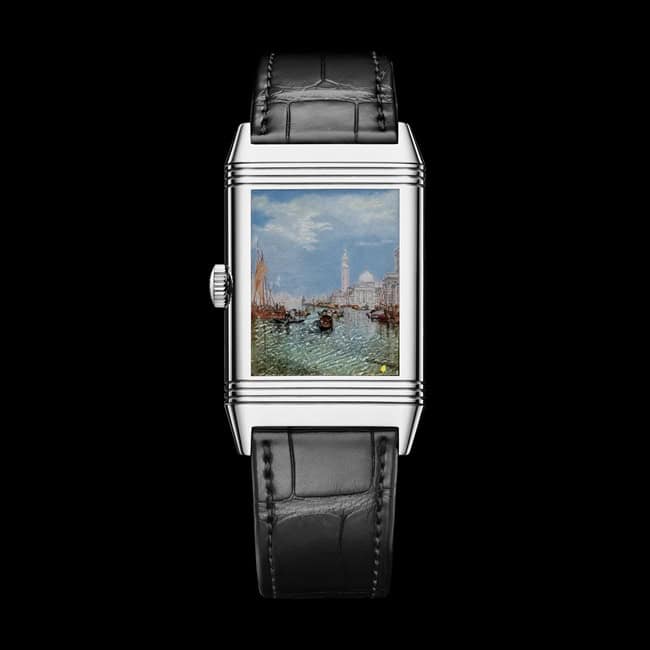
The first of the four watches takes its inspiration from Venice, the Dogana and San Giorgio Maggiore, painted by Turner in 1834. The church of San Giorgio Maggiore provides the visual anchor, its white façade emerging through the haze while buildings recede towards the horizon. Boats and gondolas animate the foreground, contrasting with the remarkably calm surface of the lagoon.
Silver paillons intensify the changing reflections of the water, while the green tones of the painting continue onto the alligator strap and the Grand Feu enamel dial. The dial itself is decorated with a soleil croisé guilloché pattern, comprising 180 engraved lines, each executed through six successive passages of the rose-engine lathe. In total, 1,080 passages are required simply to create the guilloché.
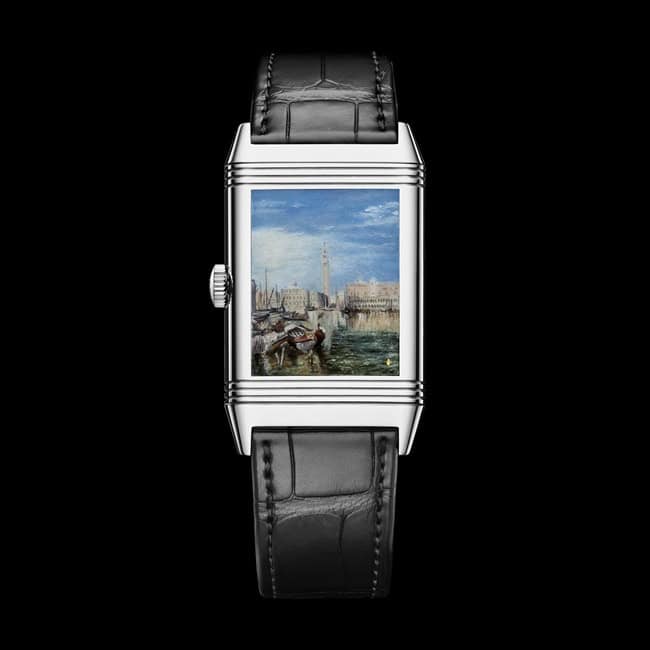
The second watch takes us to Venice, from the Porch of Madonna della Salute, Turner’s 1835 interpretation of the city. Here the architecture appears almost to dissolve into its own reflections. The hazy light creates a remarkable sense of depth, while silver paillons beneath the enamel recreate the shimmering surface of the lagoon.
The dial employs a rice-grain guilloché pattern beneath green Grand Feu enamel. Seventy precisely engraved lines, each requiring six passages of the rose engine, produce 420 operations before the enamelling process even begins.
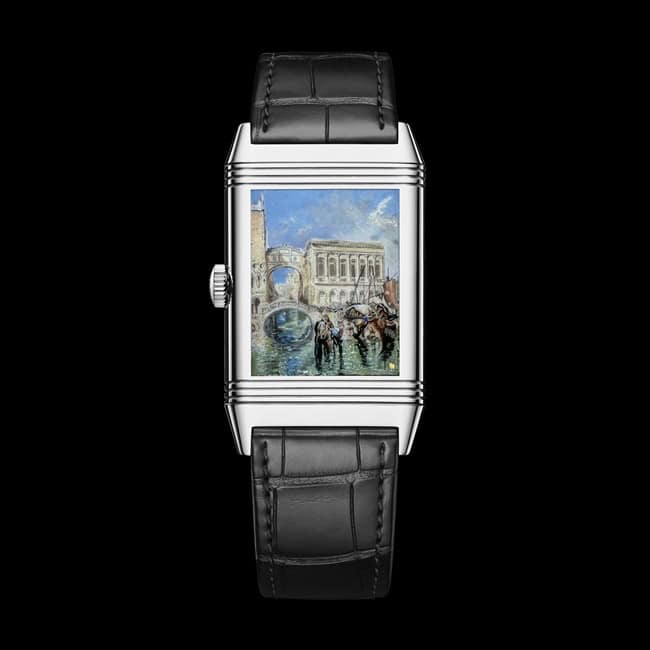
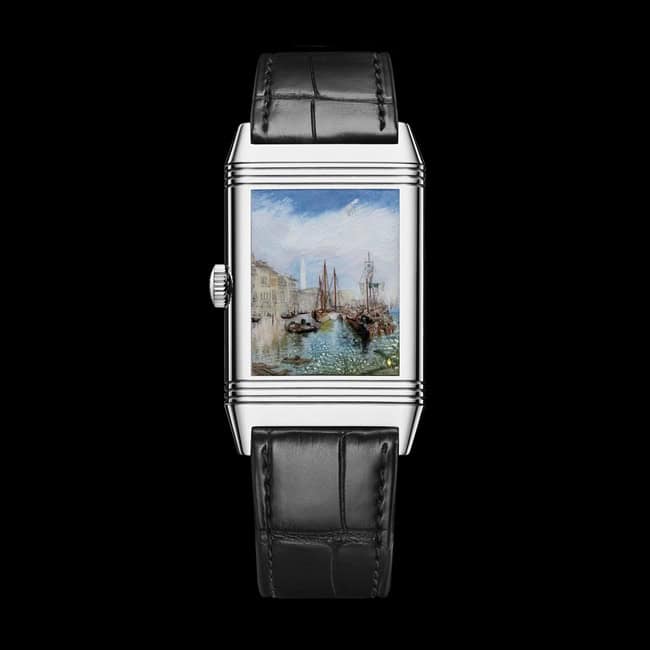
The third interpretation, Bridge of Sighs, Ducal Palace & Custom House, Venice, dates from 1833 and represents Turner’s first Venetian view painted in oils. The work also pays tribute to Giovanni Antonio Canaletto, the great 18th-century Venetian vedutista. In Turner’s original composition, Canaletto himself appears seated at his easel.
The Reverso focuses instead on the atmospheric architecture and lagoon, with the rosy coral of the Doge’s Palace set against green water and a luminous blue sky.
That blue is carried onto the dial through translucent Grand Feu enamel laid over a hand-guilloché basket-weave pattern. Forty-six finely engraved lines, each requiring six successive passages, create a subtle texture beneath the enamel.
The final watch is perhaps the most poignant of the quartet: Venice, the Bridge of Sighs, painted in 1840. Turner contrasts the darker foreground with the warm light reflected across the buildings, creating a mood that is both beautiful and melancholic. By this point, Venice itself had become a meditation on change and decline.
Turner accompanied the exhibited painting with two lines adapted from Byron:
“I stood upon a bridge, a palace and a prison on each hand.”
That sense of duality is particularly appropriate for the Reverso. A watch defined by two faces, two perspectives and a case that physically turns from one side to the other, it is perhaps the ideal horological canvas for Turner’s vision of Venice.
The dial translates the painting into a wavy hand-guilloché pattern beneath subtly tinted Grand Feu enamel. Forty-one engraved lines require 369 passages of the rose engine, creating a surface that seems to move as the wrist catches the light.
The art beneath the art
The extraordinary aspect of the Turner Series is that the decorative elements are not simply applied to an otherwise conventional watch. They form a dialogue between the front and reverse. Each dial has been conceived in response to its miniature painting. The colours, patterns and textures are deliberately connected to the corresponding Turner work, meaning that the watch becomes a continuous artistic composition when viewed from both sides.
This is particularly evident in the guilloché. Executed entirely by hand on a manually operated rose-engine lathe, the patterns require extraordinary patience and precision. Once completed, they are covered with translucent Grand Feu enamel, allowing the engraved surface to remain visible beneath the colour. The enamel itself introduces another layer of difficulty. Each dial requires between eight and nine hours of work, with up to five layers of enamel and as many as seven separate firings at 800°C.
Even the seemingly simplest details demand exceptional skill. The faceted hour markers must be fitted by drilling tiny holes through the finished enamel without causing it to crack, while the chemin de fer minute track must be applied with absolute precision. It is a reminder that on a watch of this nature, nothing is merely decorative. Every surface has been considered, every texture engineered and every colour selected to reinforce the artistic whole.
The Reverso as a work of art
Beneath this exceptional decoration lies one of Jaeger-LeCoultre’s most enduring movements: Calibre 822. Developed specifically for the Reverso and used in the collection for more than two decades, the manually wound movement measures less than 3mm in height, preserving the elegant proportions of the rectangular case. It provides 42 hours of power reserve and operates at 21,600 vibrations per hour, or 3Hz.
Yet the movement is almost deliberately understated. The mechanical heart of the watch exists to support the real point of the Turner Series: the dialogue between traditional watchmaking and the decorative arts. That dialogue has been central to the Reverso for much of its 95-year history.
Born in 1931 as a practical solution for polo players who needed to protect their watch crystals during matches, the Reverso quickly became something much more. Its Art Deco geometry and ingenious reversible case gave it an identity unlike any other watch. Its blank reverse side subsequently became a canvas for artistic expression. The Turner Series represents the latest chapter in that story.
Venice, captured in time
There is a certain irony in using a mechanical watch to preserve Turner’s paintings of Venice. His art was concerned with transience: sunlight disappearing across water, buildings dissolving into haze, reflections changing from one moment to the next. Venice itself became a metaphor for the passing of time and the fragility of permanence.
The Reverso, meanwhile, is a machine designed to measure time. Yet the two meet naturally here. Through miniature painting, Grand Feu enamel, paillonnage and hand-guilloché, Jaeger-LeCoultre has attempted to preserve something that Turner himself was constantly pursuing, the fleeting sensation of light.
The result is not simply a reproduction of four famous paintings. It is an interpretation of Turner’s fascination with Venice, translated through the hands of contemporary artisans and into the dimensions of a watch. Each of the four Reverso Tribute Enamel ‘Turner Series’ watches is limited to just 10 pieces. In a city where the light is never quite the same twice, that seems an appropriately rare way to capture a moment.
Jaeger-LeCoultre Reverso Tribute Enamel ‘Turner Series’
Four limited editions of 10 pieces each, in 18K white gold, measuring 45.6 x 27.4mm and 8.51mm thick. Each is powered by the manually wound Jaeger-LeCoultre Calibre 822 with a 42-hour power reserve and features a Grand Feu enamel and hand-guilloché dial, with a miniature Grand Feu enamel reproduction of a J.M.W. Turner Venetian painting on the reverse.
Technical Specifications:
REVERSO TRIBUTE ENAMEL ‘TURNER SERIES’ – Venice, the Dogana and San Giorgio Maggiore
Original painting: 1834, oil on canvas, 91.5 x 122 cm (National Gallery of Art, Washington DC)
Case: 18K (750/1000) white gold
Dimensions: 45.6 x 27.4 mm x 8.51 mm thick
Calibre: Manually wound Jaeger-LeCoultre Calibre 822
Functions: Hours, minutes
Power Reserve: 42 hours
Front dial: ‘Soleil croisé’ hand-guilloché, Grand Feu enamel
Caseback: Miniature-painted Grand-Feu enamel
Water resistance: 3 bar
Strap: Green alligator
Reference: Q39334W1
REVERSO TRIBUTE ENAMEL ‘TURNER SERIES’ – Venice, from the Porch of Madonna della Salute
Original painting: 1835, oil on canvas, 91.4 x 122.2 cm (The Metropolitan Museum of Art, New York)
Case: 18K (750/1000) white gold
Dimensions: 45.6 x 27.4 mm x 8.51 mm thick
Calibre: Manually wound Jaeger-LeCoultre Calibre 822
Functions: Hours, minutes
Power Reserve: 42 hours
Front dial: Rice-grain hand-guilloché pattern, Grand Feu enamel
Caseback: Miniature-painted Grand-Feu enamel
Water resistance: 3 bar
General Information
Strap: Green alligator
Reference: Q39334W2
REVERSO TRIBUTE ENAMEL ‘TURNER SERIES’ – Bridge of Sighs, Ducal Palace & Customhouse
Original painting: 1833, oil on mahogany, 51.1 x 81.6 cm, (Tate Britain collection)
Case: 18K (750/1000) white gold
Dimensions: 45.6 x 27.4 mm x 8.51 mm thick
Calibre: Manually wound Jaeger-LeCoultre Calibre 822
Functions: Hours, minutes
Power Reserve: 42 hours
Front dial: Barleycorn hand-guilloché, Grand Feu enamel
Caseback: Miniature-painted Grand-Feu enamel
Water resistance: 3 bar
Strap: Blue alligator
Reference: Q39334W3
REVERSO TRIBUTE ENAMEL ‘TURNER SERIES’ – Venice, the Bridge of Sighs.
Original painting: 1840, oil on canvas, 68.6 x 91.4 mm (Tate Britain collection)
Case: 18K (750/1000) white gold
Dimensions: 45.6 x 27.4 mm x 8.51 mm thick
Calibre: Manually wound Jaeger-LeCoultre Calibre 822
Functions: Hours, minutes
Power Reserve: 42 hours
Front dial: Wavy hand-guilloché pattern, Grand Feu enamel
Caseback: Miniature-painted Grand-Feu enamel
Water resistance: 3 bar
Strap: Blue alligator
Reference: Q39334W4
All pricing upon application.
For more information please visit Jaeger-LeCoultre