
Ruth Belville And The Business Of Time
There are few figures in horology whose tools were so simple, and whose influence was so quietly profound, as Ruth Belville (1854-1943).
She did not design a movement. She did not found a manufacture. She never chased innovation for its own sake. And yet, for decades, she was one of the most reliable sources of accurate time in Britain—perhaps the most human one.
Her instrument was a watch.
Her office was the streets of London.
Her business was time itself.
Ruth Belville was the third and final steward of what became known as the Arnold Time service, a tradition begun in 1836 by her father, John Henry Belville. Each morning, he would set a pocket chronometer—Arnold No. 485/786—at the Royal Observatory in Greenwich. He would then carry it across London, visiting clients who relied on it to synchronise their own clocks. Banks. Railway offices. Watchmakers. Institutions for whom a few seconds mattered.
This was not a novelty act. This was infrastructure.
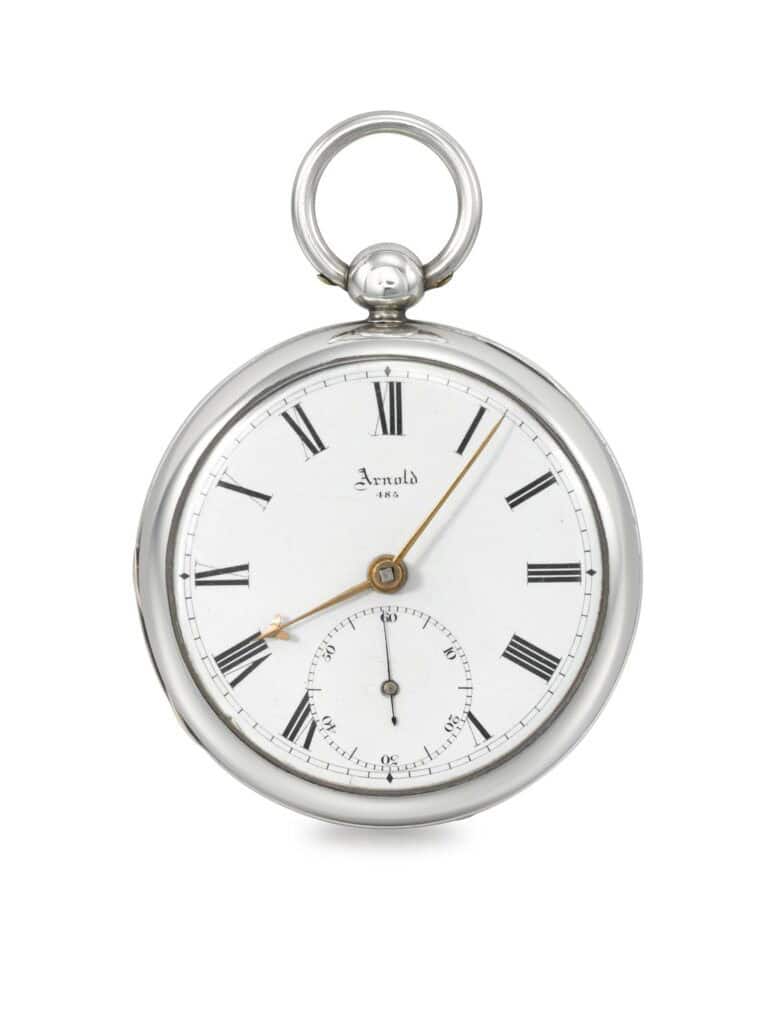
The watch itself (above) was a masterpiece of restraint: the spring detent escapement watch by John Arnold, in a later silver case had a white enamel dial with a subsidiary seconds dial and gold spade hands. It was a high quality jewelled movement with diamond endstone. The original escapement has a later conversion to Earnshaw’s spring detent arrangement, and has a later type of two-arm compensation balance. It is signed ‘John Arnold & Son, London. Invenit & fecit 485/786’. The movement is from c.1794, and the case is hallmarked for 1840, with a casemaker’s mark ‘CBH’ and stamped 485.
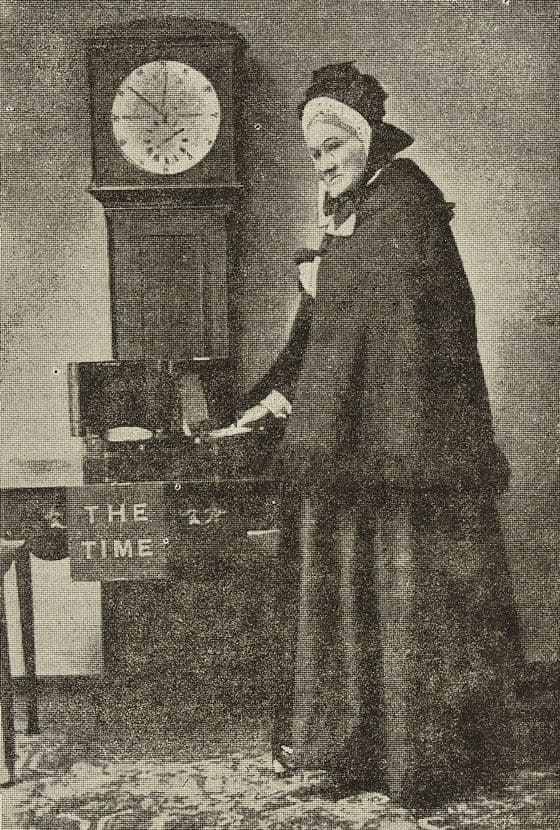
This watch was originally made for HRH the Duke of Sussex, but was substantially rebuilt c.1840. It was used from 1834 to carry correct time from the Greenwich Observatory to the London horological trade by John Henry Belville, then from 1856 – 1892 by his widow, Maria (below) and thereafter by their daughter Ruth, until she retired in 1940. Ruth Belville knew it as ‘Mr. Arnold’.
By the early 20th century, technology was already conspiring against her. Telegraph time signals were becoming widespread. The BBC would soon broadcast the time itself. Critics dismissed her work as obsolete. One prominent scientist publicly derided the idea of a woman carrying “the time of the nation” in her handbag.
Ruth did not argue. She simply kept going and her clients kept paying.
Why? Because the Arnold was trusted. Because Ruth was consistent. Because her method, though old-fashioned, was verifiable. You could see the watch. You could compare it with your own. There was no invisible signal to doubt, no interference to blame.
In an era increasingly enamoured with abstraction, Ruth offered certainty you could hold. She continued her rounds for forty-eight years, through a world that was steadily conspiring to make her irrelevant.
She walked London during the First World War. She walked it as telegraph wires were laid beneath the streets and strung above them, carrying time at the speed of electricity rather than the pace of a measured step. Each new advance promised efficiency. Each one predicted her disappearance.
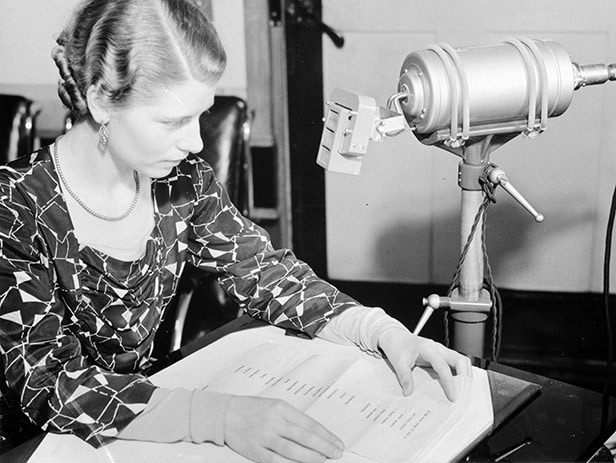
In 1924, the BBC began broadcasting the sound of Big Ben itself. For the first time, accurate time entered homes without effort—no appointment, no comparison, no human intermediary. Later, in 1936, came ‘Tim’, the speaking clock. Dial 846—T-I-M—and a disembodied voice would tell you the time with calm authority. Precision had become anonymous. Ubiquitous. Cheap.
This was the slow unravelling of Ruth Belville’s trade.
Not because her watch had failed her, but because the world had decided it no longer needed to see time to believe it. The Arnold was still accurate. Ruth was still meticulous. What changed was convenience.
She retired in 1940 at the age of eighty-five, not defeated by technology but constrained by circumstance. Wartime London was no place for an elderly woman to walk alone, even one carrying the nation’s time in her pocket. With her retirement, the Belville family’s century-long business came quietly to an end.
Ruth died in 1943, three years later, with the Arnold reportedly resting by her bedside. It is hard to imagine a more fitting vigil. A watch that had measured the lives of others, now keeping silent company at the close of her own.
In recognition of her lifelong service, the Worshipful Company of Clockmakers provided Ruth with a pension after her retirement. Upon her death, the Arnold chronometer was bequeathed to the Company, where it remains in the Clockmakers’ Museum at the Science Museum, South Kensington in London.
In a world of atomic clocks and satellite synchronisation, Ruth Belville’s legacy feels almost defiant. One woman. One watch. One daily walk from Greenwich into the city.
And for a very long time, that was enough to keep London on time.
Hero Image: Ruth Belville outside the gates of the Greenwich Observatory, 1908. Public domain