
John Harrison Commemorated In New Stamp Collection
Two hundred and fifty years after the death of John Harrison, a new Isle of Man stamp collection celebrates the Yorkshire clockmaker whose obsession with precision helped unlock the oceans.
There are moments in the history of horology when a clock becomes something more than an instrument for telling the time. John Harrison’s clocks were such objects. They were instruments of navigation, experiments in precision, expressions of extraordinary mechanical ingenuity and, ultimately, tools that helped change the way the world was mapped.
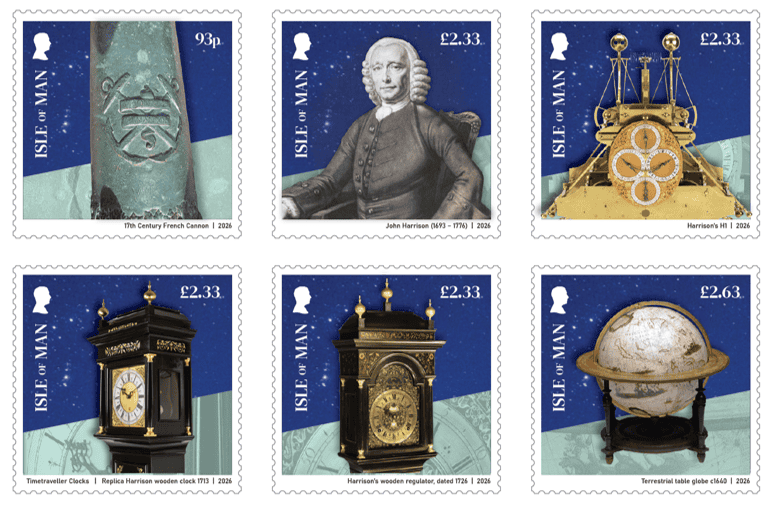
To mark the 250th anniversary of Harrison’s death, the Isle of Man Post Office is celebrating his life and inventions with a new collection of six stamps, issued on 20th September 2026. The collection traces the story from the dangers of eighteenth-century navigation to Harrison’s remarkable marine timekeepers and his enduring contribution to precision timekeeping.
For collectors of watches and clocks, it is a reminder that some of the most important developments in horology were never intended simply to sit on a mantelpiece or be worn on the wrist. They were built to survive the movement of the sea.
By the eighteenth century, determining latitude was comparatively straightforward. A navigator could establish north-south position through observations of the sun and stars. Longitude was another matter.
Knowing how far east or west a ship had travelled required an accurate comparison between local time and a known reference time. At sea, where temperature, humidity, motion and changing conditions could wreak havoc with conventional clocks, maintaining that accuracy was an immense technical challenge. The consequences were potentially catastrophic.
Shipwrecks, lost cargoes and the loss of life were all part of the price of inadequate navigation. The wreck of HMS Association off the Isles of Scilly in 1707, in which around 2,000 people perished, became one of the disasters associated with the increasingly urgent search for a dependable method of finding longitude at sea.
In 1714, Parliament established the Longitude Prize, offering a substantial reward for a practical solution. Harrison accepted the challenge in the most Harrison-like way possible. He built a clock.
Stamp 1, 17th Century French Cannon: This 17th century French cannon that was captured by the Royal Navy from the French fleet at the Battle of Vigo Bay in 1702 and was aboard HMS Association when it shipwrecked off the Isles of Scilly in 1707, in one of the worst disasters in the British naval history. The wreck, in which around 2,000 souls perished, contributed to the increasingly urgent need for accurate methods of determining longitude at sea.
Stamp 2, John Harrison (1693 – 1776): John Harrison was a self-taught English carpenter, clockmaker and inventor whose revolutionary timekeepers transformed navigation. Born in Yorkshire, he displayed exceptional mechanical talent from an early age and devoted much of his life to solving the longitude problem.
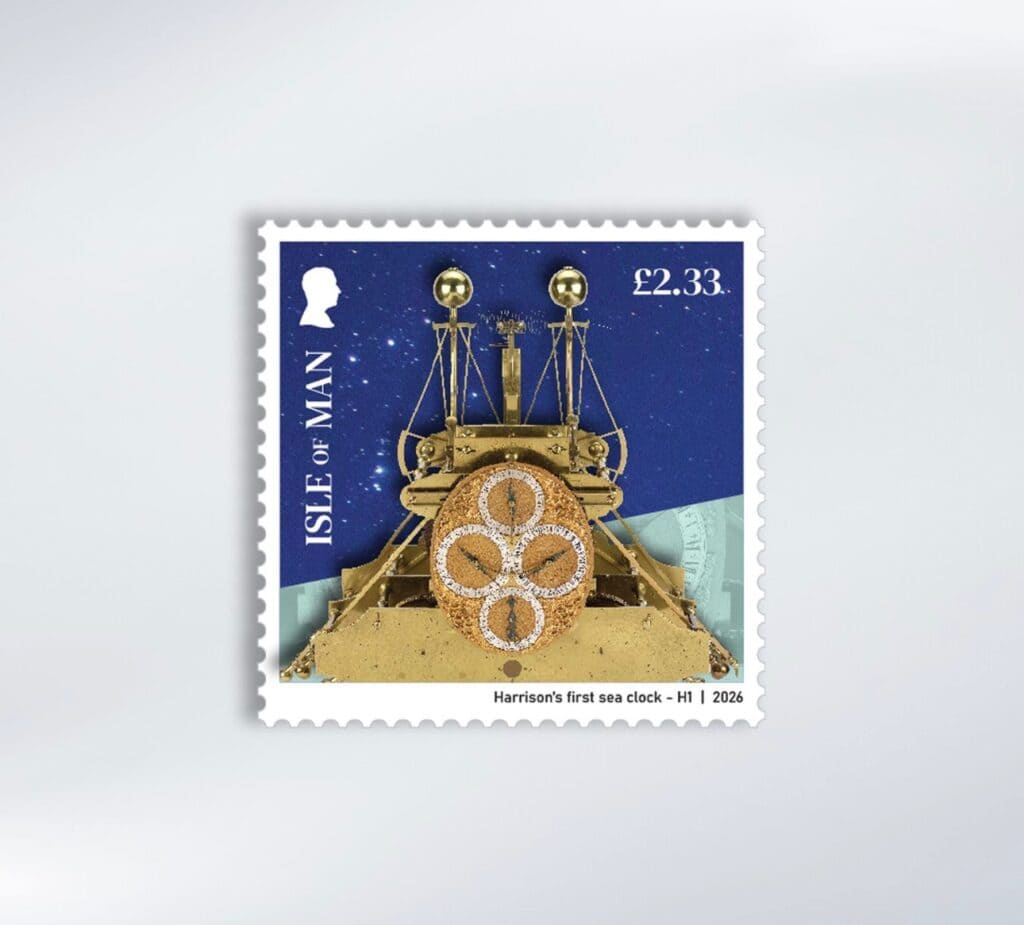
Stamp 3, Harrison’s H1 – The First Sea Clock: This stamp features Harrison’s H1 marine timekeeper, completed in 1735. In 1714, the British Parliament established the Longitude Prize to encourage a solution to the longitude problem, and H1 was Harrison’s first response to that challenge. Designed specifically for use aboard a moving ship, it demonstrated that precise timekeeping could be maintained at sea and proved that a clock-based solution to longitude was achievable.
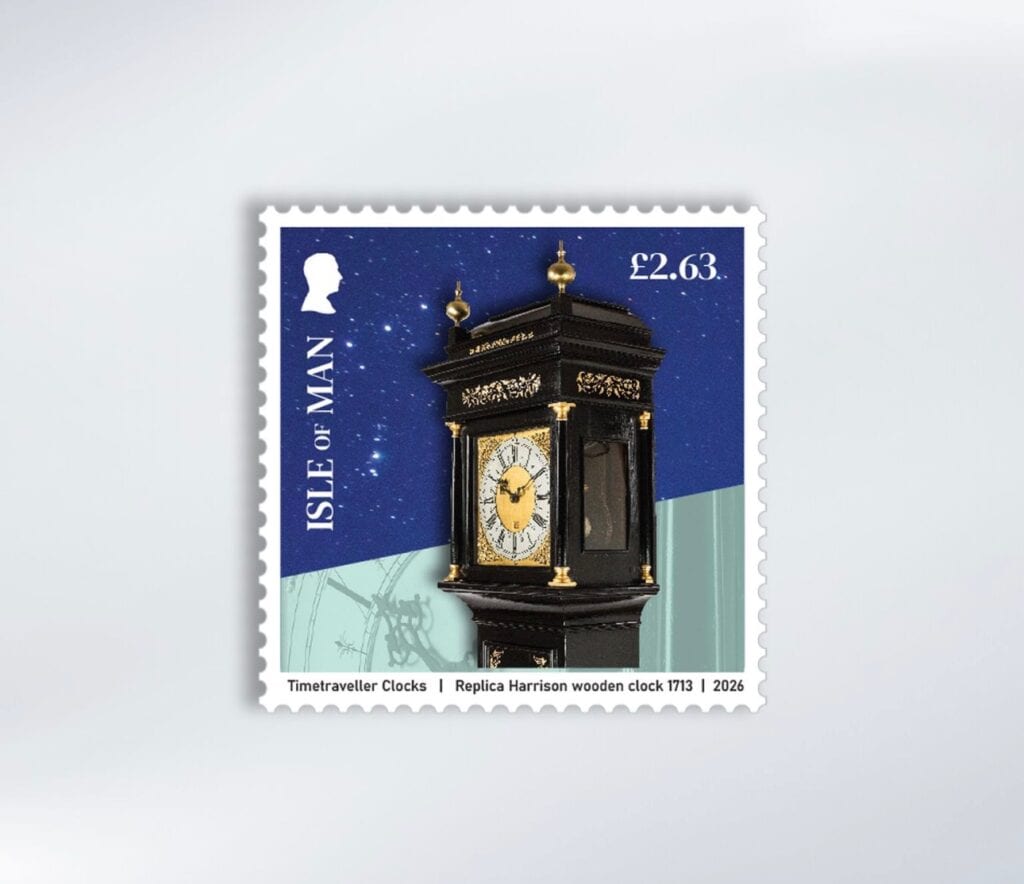
Stamp 4, Replica Harrison Wooden Clock, 1713: This replica wooden clock represents one of Harrison’s earliest surviving achievements as a clockmaker. Built largely from oak and other native timbers, it reflects the traditions of rural English craftsmanship during the early 18th century.
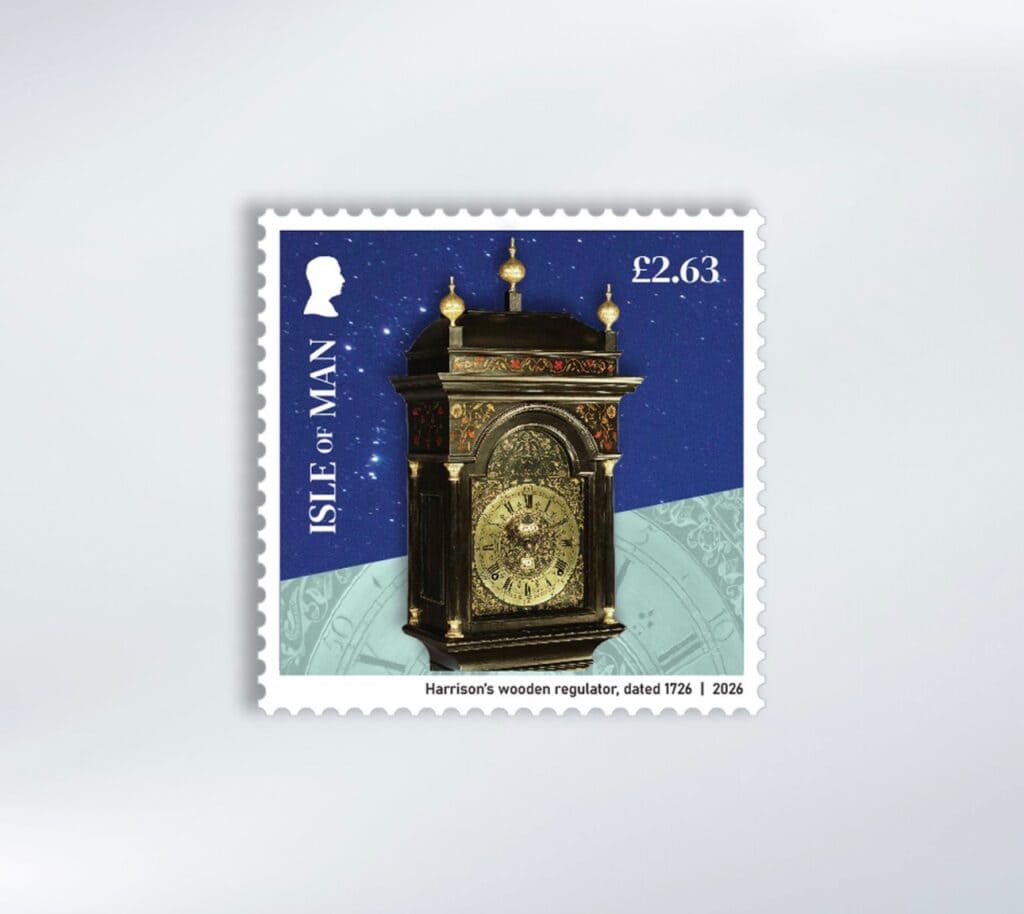
Stamp 5, Harrison’s Wooden Regulator, Dated 1726: This highly accurate regulator clock illustrates Harrison’s continuing quest for precision. During the 18th century, accurate clocks were essential for astronomy, navigation and scientific research, and Harrison constantly strove to improve their performance.
Stamp 6, Terrestrial Table Globe, c.1640: The terrestrial globe symbolises the wider geographical and navigational challenges of Harrison’s age. By the 17th and 18th centuries, sailors could determine latitude with reasonable accuracy using observations of the sun and stars, but longitude remained notoriously difficult to calculate. Harrison’s timekeepers provided the breakthrough that navigators had long sought.
John Harrison (1693–1776) was born in Yorkshire and was largely self-taught. His background was that of a carpenter and clockmaker rather than an academic scientist, but he possessed an extraordinary mechanical imagination. His early clocks already demonstrated an unusual approach to precision.
A replica of his wooden clock of 1713 and his wooden regulator of 1726 are represented in the Isle of Man issue, illustrating the progression of a craftsman whose fascination with accuracy would eventually take him far beyond conventional domestic clockmaking. Harrison’s great achievement was not simply making a clock more accurate. It was understanding what a clock would have to endure at sea and then designing accordingly.
The third stamp in the collection depicts Harrison’s H1, completed in 1735. H1 was his first major response to the Longitude challenge: a marine timekeeper designed specifically to operate aboard a moving vessel.
That distinction is crucial. A precision clock in a workshop is one thing. A precision clock on a ship pitching and rolling in the Atlantic is something altogether different.
Harrison’s solution demonstrated that a clock-based approach to determining longitude was viable. The familiar narrative of Harrison is therefore not simply one of a genius inventing a marine chronometer. It is a story of relentless experimentation. H1 was the beginning, not the end.
His subsequent timekeepers would become progressively more sophisticated as he pursued greater accuracy, smaller dimensions and improved performance. The problem was enormous. So was the determination required to solve it.
Perhaps the most interesting aspect of the new stamp collection is the way it places Harrison’s work within the much broader history of navigation.
One stamp depicts a seventeenth-century French cannon captured at the Battle of Vigo Bay in 1702 and subsequently aboard HMS Association. Another shows a terrestrial globe dating from around 1640. They are not clocks, but they help tell the story.
The globe represents the geographical problem confronting navigators; the cannon represents the very real dangers of maritime travel. Between them sits Harrison, whose work transformed an abstract scientific problem into a practical mechanical solution. It is a particularly appropriate story for the Isle of Man, an island whose own history has always been closely connected to the sea.
The collection has been curated with the assistance of Dr John C Taylor OBE, himself an inventor, entrepreneur, philanthropist and horologist, and a recipient of the Harrison Medal for his contribution to the understanding of clockmaking and horology. Taylor’s connection to Harrison is particularly fitting.
“Few individuals have altered the course of history through such focused, dogged determination as John Harrison. By harnessing the power of precise timekeeping, he unlocked the oceans and helped connect the world. Two hundred and fifty years on, his enduring legacy reminds us how ingenuity, patience and craftsmanship can change the future.” Dr John C Taylor OBE
Educated at King William’s College on the Isle of Man before later making the Island his home, he has devoted considerable attention to understanding and communicating the achievements of the eighteenth-century clockmaker. He is also Patron of Clocktime, the charity dedicated to promoting horology and British clock and watchmaking. For Taylor, Harrison’s achievement is about more than mechanical ingenuity.
For horological collectors, the issue goes beyond the six stamps themselves. The Isle of Man Post Office has produced a wider range of material, including a First Day Cover, Presentation Pack, Booklet Pane and, particularly interestingly, a 28-page Prestige Booklet containing extended essays and imagery on Harrison’s life by Dr Taylor.
Two complete mint sets are bound into the Prestige Booklet, turning what might otherwise be a conventional philatelic issue into a compact piece of horological reference material. There is something rather appropriate about that. Harrison’s story has always crossed the boundaries between disciplines. It belongs simultaneously to clockmaking, engineering, navigation, science and maritime history.
And it demonstrates something that collectors of fine watches and clocks understand instinctively: the significance of a timepiece is not always contained within its appearance. Sometimes its importance lies in what it made possible.
Released on 20th September 2026, the John Harrison Life & Inventions issue is available online at iomstamps.com/collections/JohnHarrison. The collection includes a Set, First Day Cover, Presentation Pack, Prestige Booklet and Booklet Pane