
Jaeger-LeCoultre 101 Secrets Hides Time In Plain Sight
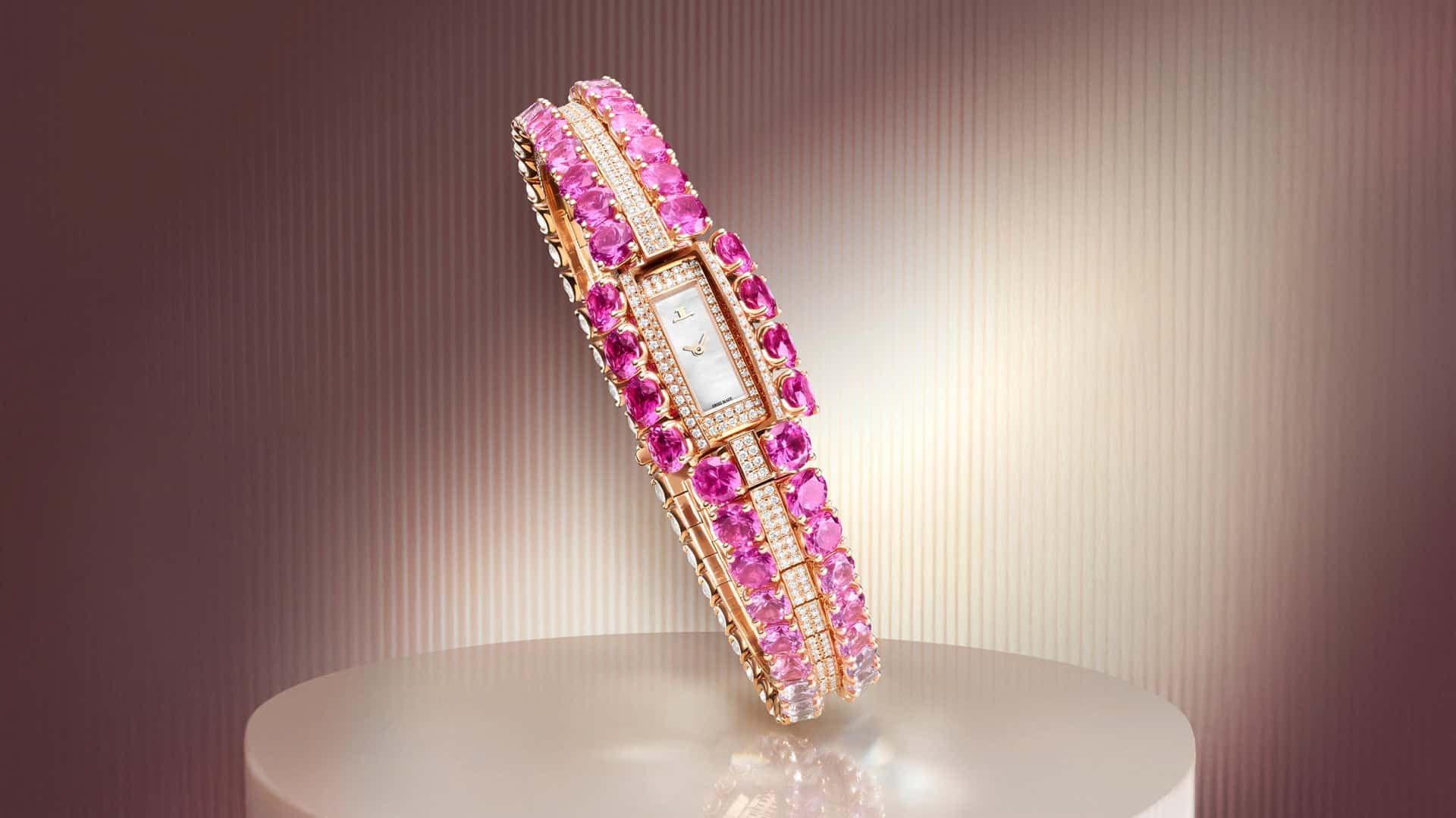
There is something inherently intriguing about a secret watch. Unlike the conventional timepiece, designed to display its purpose openly, the secret watch asks its wearer to reveal the time only when required. It is an idea rooted in discretion, but also one that offers watchmakers and jewellers an extraordinary opportunity to explore the boundaries between horology and adornment.
Jaeger-LeCoultre’s new 101 Secrets takes this tradition into the realm of High Jewellery, combining the Maison’s legendary Calibre 101 with an extraordinary composition of pink sapphires, diamonds, mother-of-pearl and 18k pink gold. Limited to just three pieces, it is as much a celebration of miniature mechanical engineering as it is of the art of gem-setting. At its heart is one of the great achievements in the history of watchmaking.
The art of making time smaller
The history of portable timekeeping has always been closely connected with miniaturisation. From the moment clocks began to be reduced to dimensions that could be carried, watchmakers have faced the same fundamental challenge. How could a mechanism be made smaller without sacrificing precision, reliability or robustness? Jaeger-LeCoultre has been pursuing an answer to that question for well over a century.
By the late 19th and early 20th centuries, the Manufacture had established considerable expertise in the creation of diminutive movements. The LeCoultre Calibre 7HP, introduced in 1880 for small enamelled and gem-set watches, was followed by the Calibre 6EB in 1908, a movement measuring barely more than a centimetre square. The decisive breakthrough came in the 1920s.
As wristwatches began to replace pocket watches and changing lifestyles encouraged smaller and more imaginative designs, LeCoultre developed the Duoplan. Patented in 1925, its ingenious two-level architecture separated the escapement from the barrel and gear train, effectively reducing the space required by the mechanism. Four years later, the Manufacture went further. In 1929, Calibre 101 was introduced.
A landmark in miniature watchmaking
Measuring just 14mm long, 4.8mm wide and 3.4mm thick, the original Calibre 101 occupied a volume of only 0.2cm³. Its 74 components weighed barely one gram, approximately the weight of two butterflies. Yet this microscopic mechanism was a fully functional mechanical movement.
Its balance oscillated at 21,600 vibrations per hour, while its mainspring provided a 33-hour power reserve. Most remarkable of all, it was created decades before computer-aided design, laser cutting and CNC machining became available. Calibre 101 was therefore not simply a small movement. It was an extraordinary demonstration of what could be achieved through traditional watchmaking skill, patience and precision. More than nine decades later, its fundamental dimensions and architecture remain unchanged.
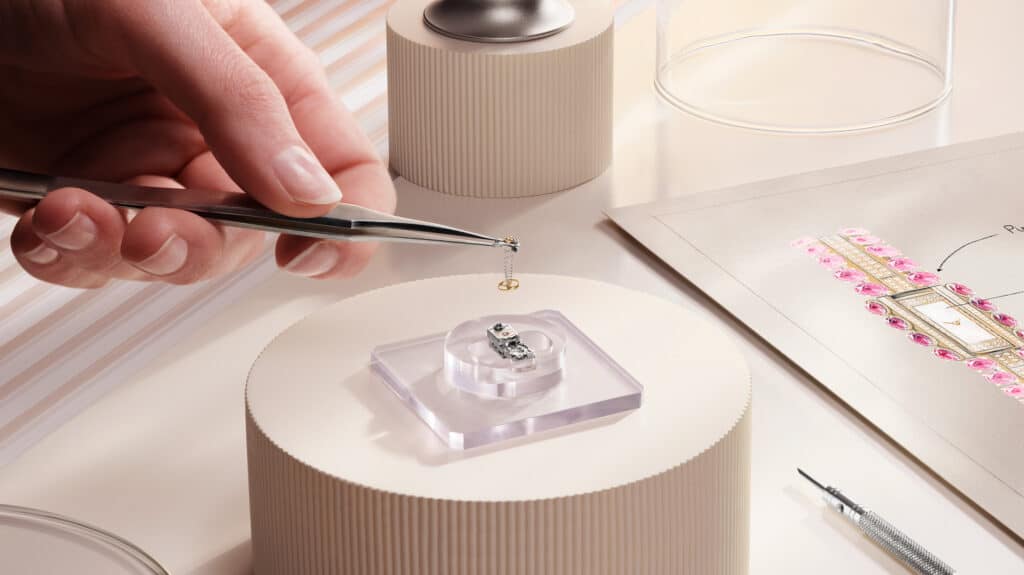
Today’s fifth-generation Calibre 101 contains 98 components, each of which must be individually produced and adjusted on a microscopic scale. Assembly takes around 40 hours and requires specialist knowledge possessed by only a handful of watchmakers. Production is consequently limited to only a few dozen movements each year. It is this remarkable movement that provides the mechanical heart of the new 101 Secrets.
The tradition of the secret watch
The concept of hiding the time has a long and fascinating relationship with jewellery. During the 18th and 19th centuries, portable watches became important symbols of status and privilege at the Royal Courts of Europe. Their cases and dials became canvases for goldsmiths, enamellers, engravers, lapidaries and gem-setters, bringing the worlds of watchmaking and jewellery increasingly together.
By the beginning of the 20th century, wristwatches had become particularly associated with women’s jewellery, creating new opportunities for watchmakers to conceal the mechanics of timekeeping within increasingly elaborate forms. The secret watch took this idea further.
Rather than presenting the dial continuously, a hinged cover could conceal it until the wearer chose to reveal the time. The arrangement offered discretion while simultaneously creating a generous surface upon which jewellery craftsmanship could take centre stage. Jaeger-LeCoultre’s new 101 Secrets draws directly upon this heritage.
A secret concealed within gemstones
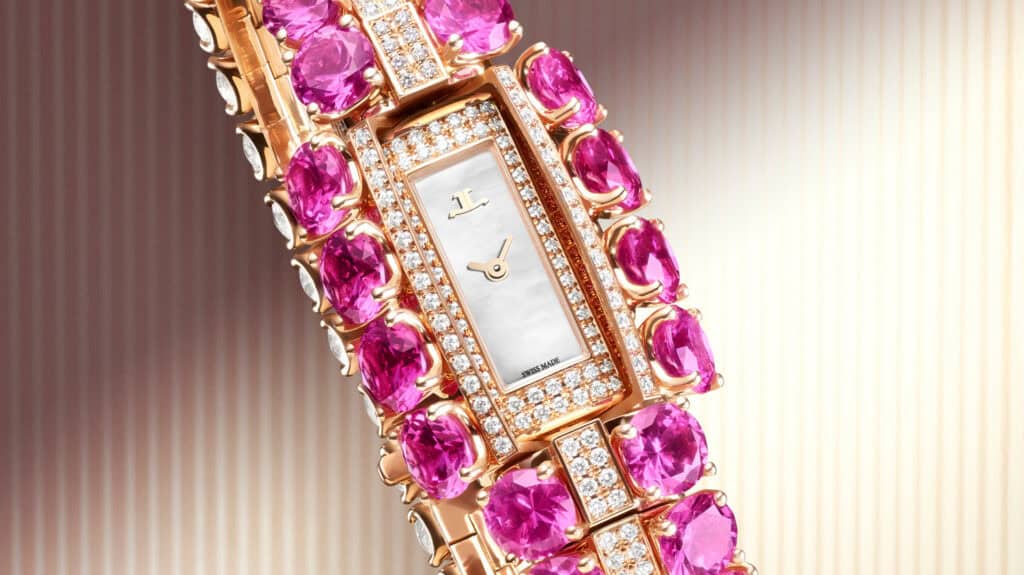
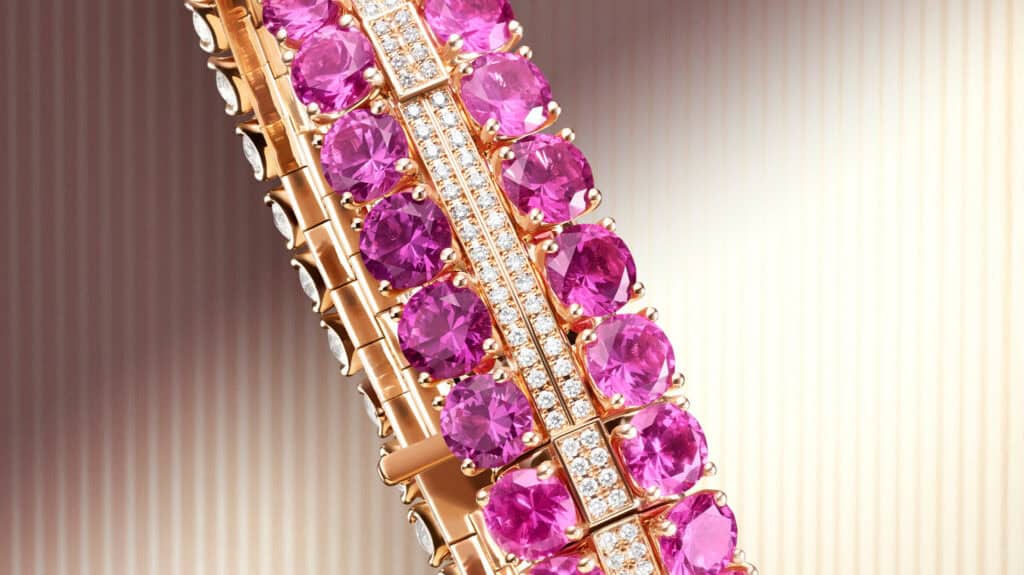
At first glance, 101 Secrets appears to be an exquisite rivière-style bracelet, its surface alive with graduated shades of pink. Look more closely and the watch reveals itself. The bracelet is crafted from 18k pink gold and set with 124 brilliant-cut pink sapphires, totalling approximately 16.39 carats. The stones graduate in both size and colour across ten sizes and seven shades, moving from vivid cyclamen to the palest blush.
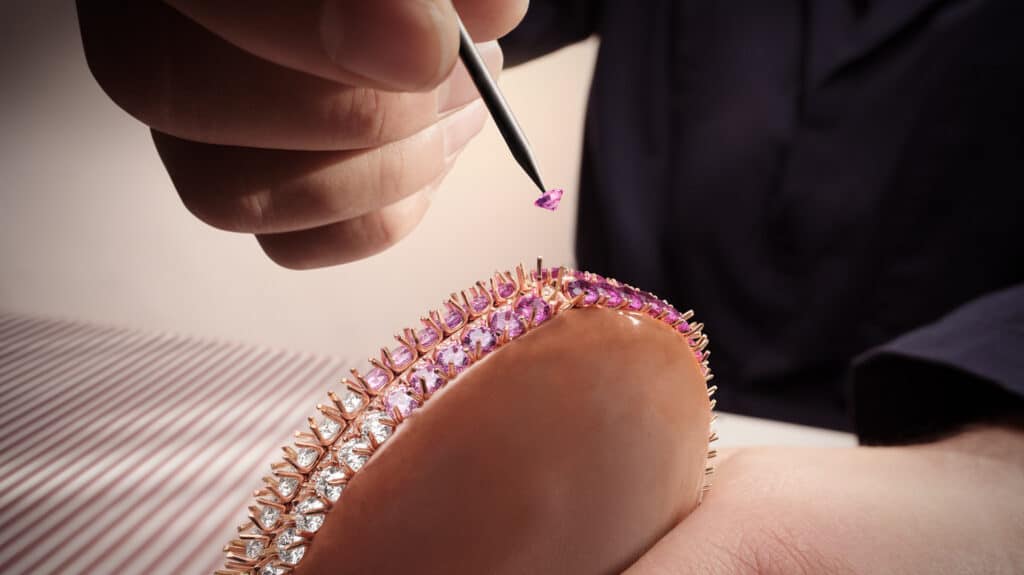
Between the two rows of sapphires is a contrasting band of grain-set white diamonds. The stones are claw-set to allow light to enter from multiple directions, enhancing both their colour and brilliance. The gem-setting continues along the case and bracelet, where diamonds extend through the length of the design.
In total, the watch incorporates 904 brilliant-cut diamonds, weighing approximately 13.26 carats, together with the pink sapphires. The rectangular bezel frames a glowing white mother-of-pearl dial, which remains hidden until the wearer chooses to reveal it. The entire gem-setting process required 163 hours of work in Jaeger-LeCoultre’s Métiers Rares™ atelier at the Manufacture. But the most intriguing aspect of 101 Secrets is not immediately visible.
The mechanism of revelation
The secret is concealed within the jewellery itself. A tiny button positioned at six o’clock is known only to the wearer. When pressed and held, a section of the bracelet opens like the pages of a book, revealing the rectangular dial beneath.
Release the button and the dial disappears once again, returning the watch to its guise as a jewel-encrusted bracelet. Creating this mechanism presented a considerable challenge. The opening system had to be sufficiently small to disappear completely within the rows of gemstones, while remaining reliable and precise enough to operate intuitively. Even the clasp required its own concealed miniature mechanism.
Here, the technical and decorative aspects of the watch cannot really be separated. The gemstones are not simply decoration placed around a movement. They form part of the architecture within which the mechanical and opening systems must operate. It is a remarkable example of micromechanics hidden in plain sight.
Where jewellery becomes horology
The appeal of 101 Secrets lies in this tension between what is seen and what remains hidden. The bracelet announces itself as a piece of High Jewellery, its succession of pink sapphires creating a continuous ribbon of colour around the wrist. Yet concealed within it is one of the most historically significant miniature mechanical movements ever created.
The result is a particularly Jaeger-LeCoultre expression of watchmaking. The technical achievement is not displayed through an openworked dial or an elaborate complication. Instead, the movement performs its role almost invisibly. This is horology as a secret.
It also demonstrates the extraordinary creative freedom offered by Calibre 101. Because the movement is so small, the watchmaker and jeweller can explore forms that would be impossible with a conventional movement. The mechanism effectively disappears, leaving the exterior free to become an object of jewellery. Yet when the hidden button is pressed, the jewel transforms. Time appears.
A legacy that continues
Since its introduction in 1929, Calibre 101 has remained remarkably consistent, even as manufacturing technology has evolved around it. Its continued production is testament to an achievement that was extraordinary when first conceived and remains extraordinary today.
The new 101 Secrets therefore represents more than another High Jewellery interpretation of a historic movement. It connects three distinct strands of Jaeger-LeCoultre’s history. The Maison’s pursuit of miniaturisation, its long tradition of mechanical innovation and its expertise in the decorative arts. All three converge within a watch that deliberately refuses to behave like a conventional watch.
With its 18k pink gold case and bracelet, 124 pink sapphires, 904 diamonds and mother-of-pearl dial, 101 Secrets is an object of exceptional visual refinement. Beneath the gemstones, however, lies Calibre 101, still embodying the principle that inspired its creation almost a century ago. Make the mechanism smaller. Make no compromise in its performance, and perhaps most importantly, never stop exploring what a watch can become.
Produced as a limited edition of just three pieces, the Jaeger-LeCoultre 101 Secrets is a dazzling contemporary expression of a very old idea. Sometimes the most captivating way to tell the time is to keep it hidden.
Technical Specifications:
CALIBRE 101 SECRETS
Case: 18K Pink Gold (750/1000)
Dimensions: 29.07 x 12.22 mm x 9.88 mm
Calibre: Manually wound, Calibre 101
Functions: Hours, minutes
Power Reserve: 33 hours
Dial: Mother-of-pearl
Gemstones: 124 pink sapphires (approximately 16.39 carats)
904 diamonds (approximately 13.26 carats)
Strap: 18k Pink Gold (750/1000) set with brilliant-cut pink sapphires and brilliant-cut diamonds; wrist size 160 mm
Reference: Q2872310
Limited edition of 3 pieces
Price upon request
For more information please visit Jaeger-LeCoultre