
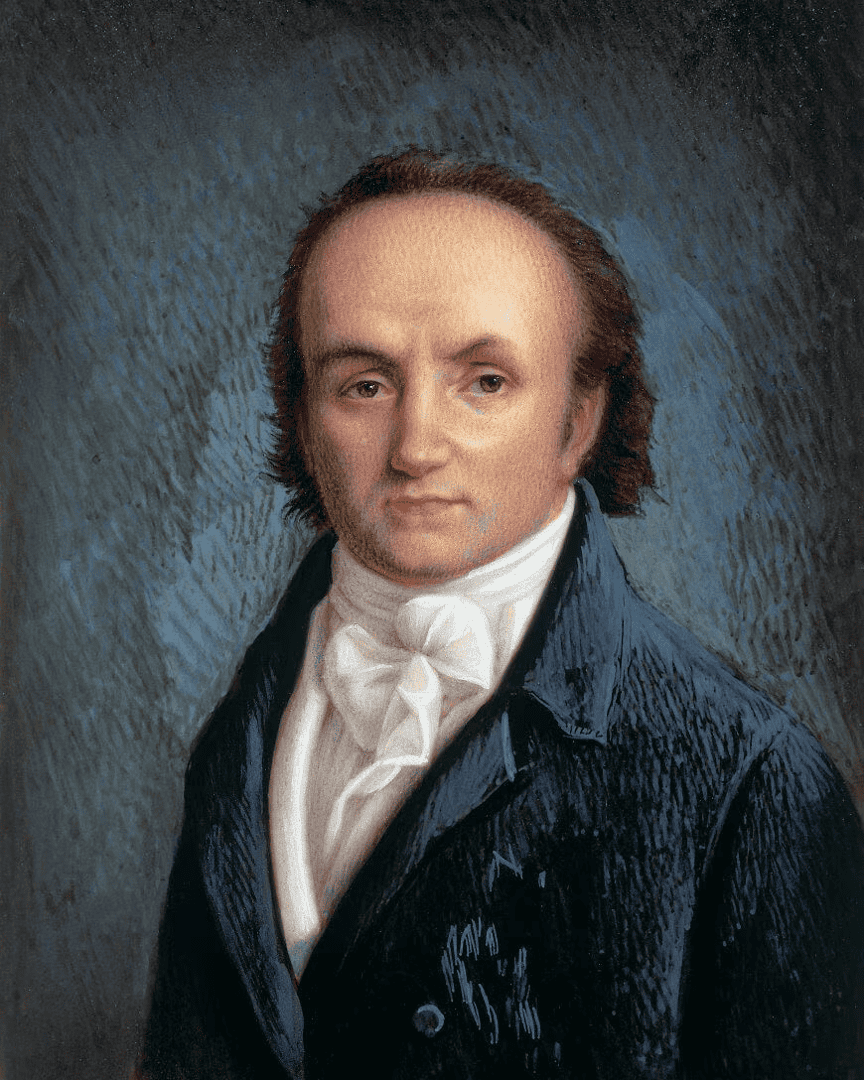
The Greatest Horologists Of Their Time: Abraham-Louis Breguet (1747-1823)
In this occasional series, we will explore the life and achievements of the greatest and most respected horologists of their time. This feature will focus on Abraham-Louis Breguet, who was to watchmaking what Leonardo da Vinci was to art, a visionary whose ideas transformed his discipline forever. Revered by royalty, admired by scientists and emulated by generations of craftsmen, he elevated horology from a skilled trade to a sophisticated science and thriving business. From the invention of the tourbillon to the refinement of self-winding watches and shock-protection systems, Breguet’s innovations continue to influence the timepieces we wear today.
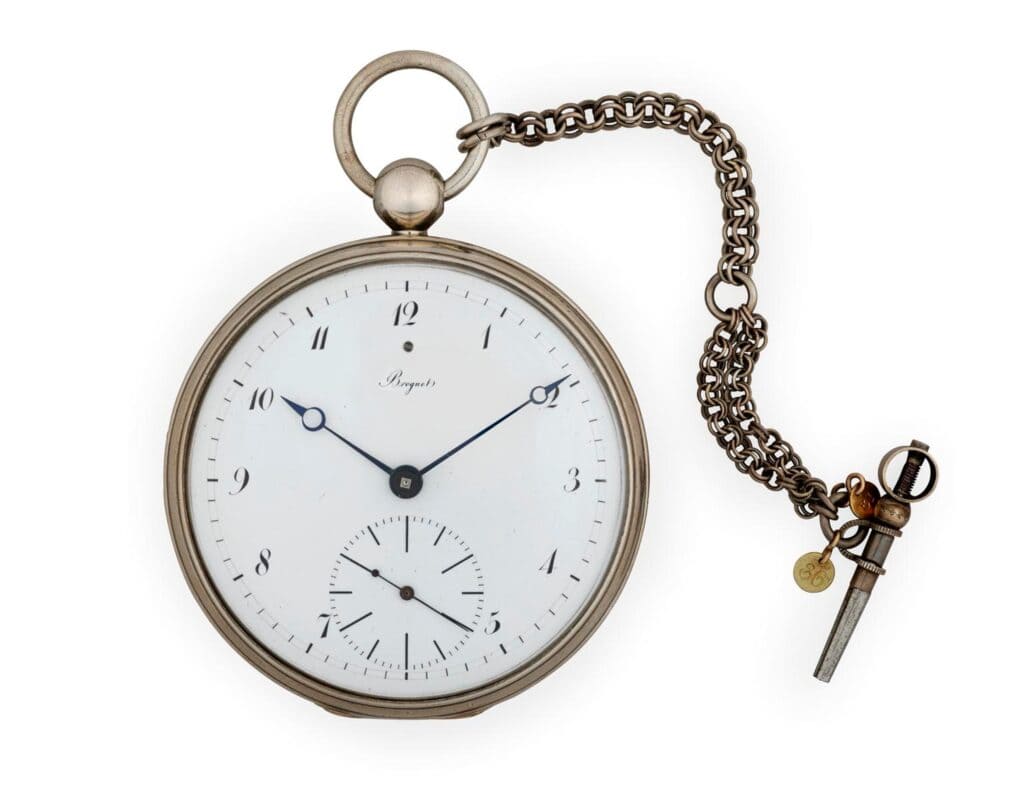
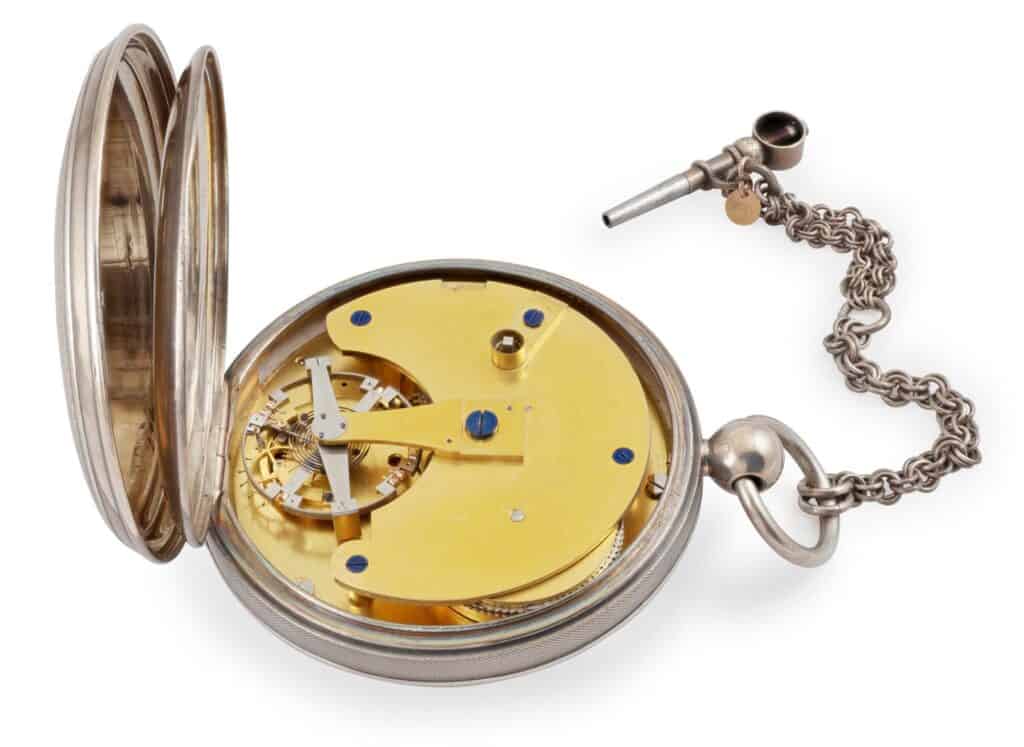
Above: Silver one-minute tourbillon watch by Abraham-Louis Breguet, 1812, London. Science Museum Group/The Clockmakers’ Museum © The Board of Trustees of the Science Museum
More than two centuries after his death, the influence of Abraham-Louis Breguet remains so pervasive that it is almost impossible to imagine horology without him. His inventions, aesthetic codes and technical solutions continue to shape contemporary watchmaking, while his name has become synonymous with innovation, elegance and precision. Few individuals have left such an enduring mark on their craft.
Born in Neuchâtel, Switzerland, in 1747, Breguet displayed an aptitude for mechanics from an early age. After training in Versailles, he established his own workshop on Paris’s Quai de l’Horloge in 1775. It was a fortuitous location for a man who would soon become the most celebrated watchmaker in Europe. His clientele would eventually include kings, queens, emperors, scientists and statesmen. Yet it was not social prestige that secured his legacy, it was an extraordinary ability to solve horological problems with originality and elegance.
At a time when watches were often unreliable and fragile, Breguet pursued precision with relentless determination. His workshop became a laboratory of invention. In 1780 he developed one of the earliest successful self-winding watches, known as the Perpétuelle, eliminating the need for frequent manual winding. The concept transformed convenience for watch owners and represented a significant leap forward in portable timekeeping.
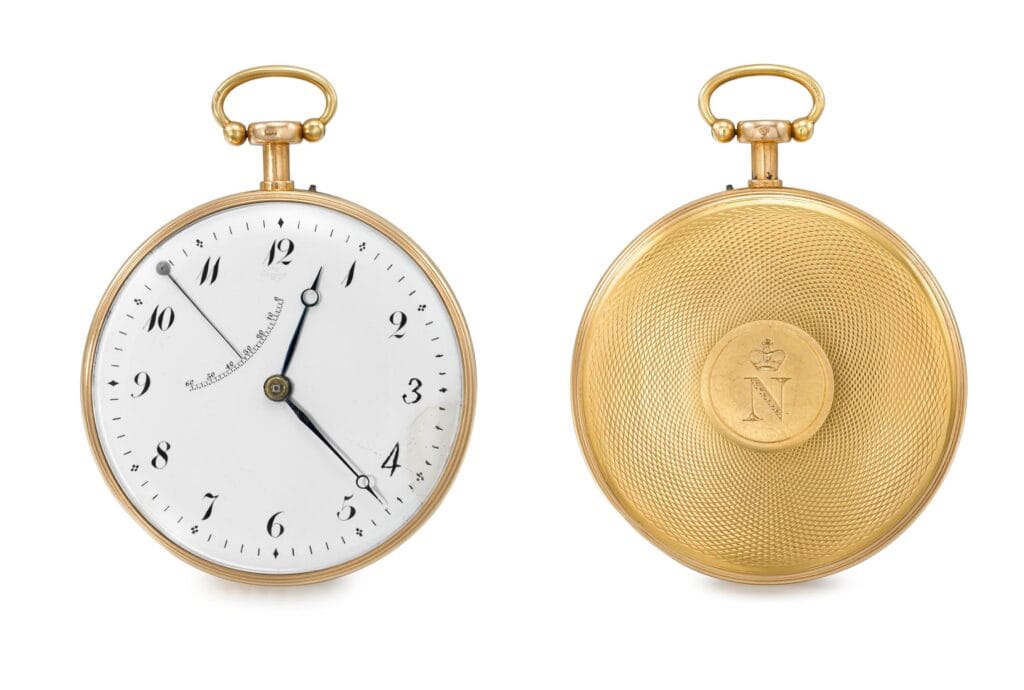
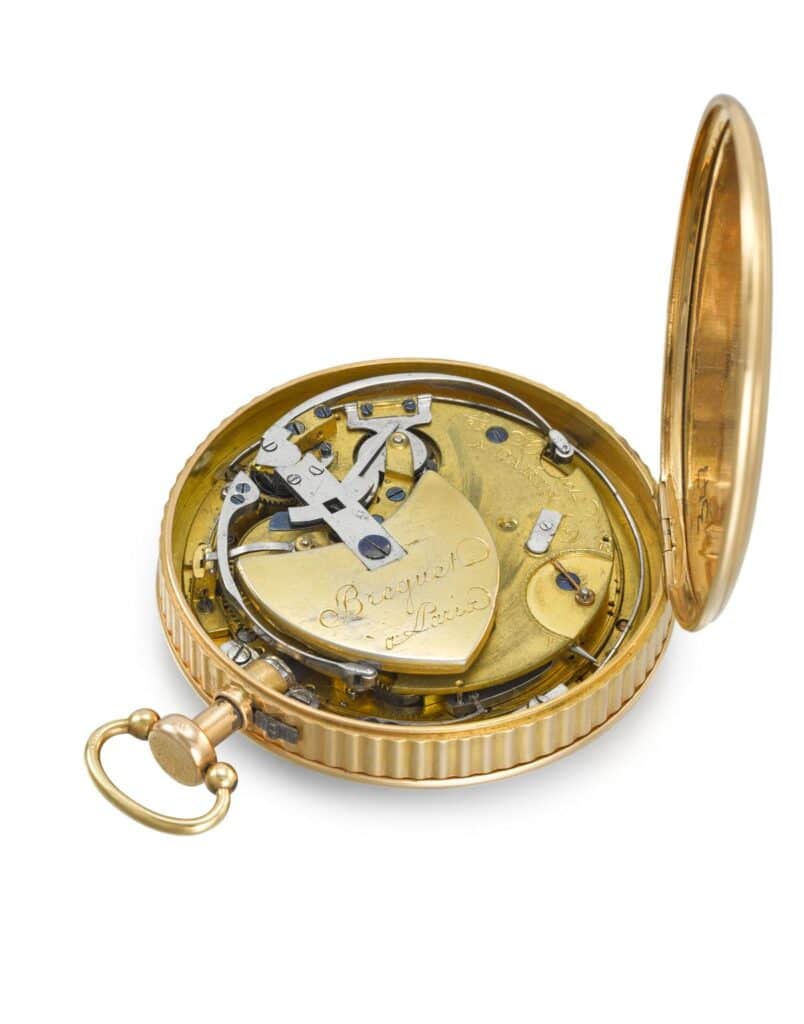
This watch above is a very early example of a ‘perpetuelle’ or self-winding watch. It is said to have been sold to the Grand Duke Nicholas of Russia (later Czar Nicholas I) although Nicholas, who was born in 1796, would not have been alive when the watch was first commissioned, and would have only been around four years old when it re-cased with a short pendant by Breguet c. 1800.
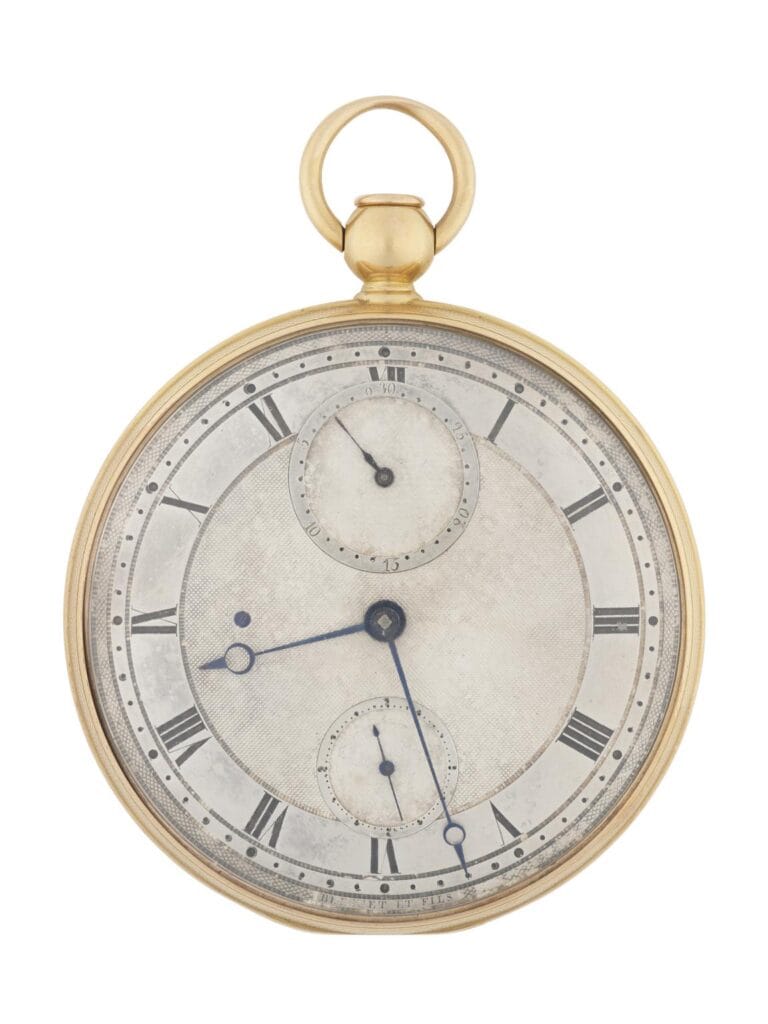
His innovations were not limited to mechanics. Breguet also revolutionised watch design. The instantly recognisable open-tipped blued steel ‘moon’ hands (below) that now bear his name first appeared during the 1780s, alongside distinctive numerals and finely executed guilloché dials. These were not merely decorative flourishes. Guilloché improved legibility by reducing reflections and clearly separating different indications on the dial. In Breguet’s hands, aesthetics and functionality became inseparable.
Perhaps his most practical invention arrived around 1790 with the development of the pare-chute, an ingenious shock-protection system designed to safeguard the delicate pivots of a watch’s balance wheel. Long before modern anti-shock devices became standard, Breguet had recognised one of the greatest vulnerabilities in portable timekeeping and devised a solution. The pare-chute is widely regarded as the ancestor of every modern shock-absorption system used in watches today.
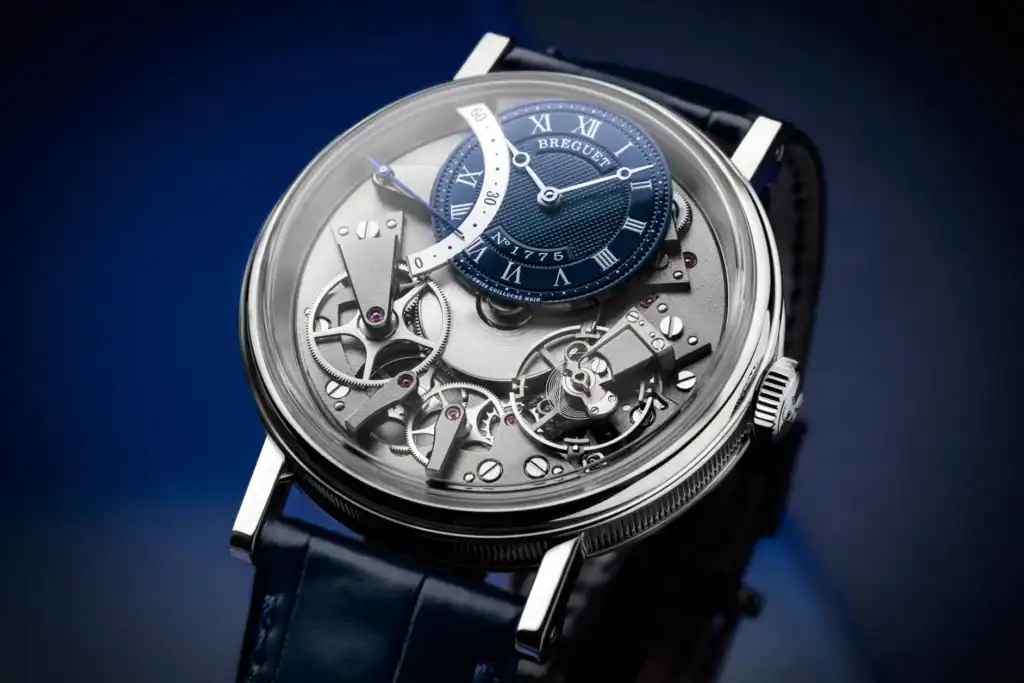
The Breguet Tradition 7027 (above), celebrates the pare-chute’ through the beautiful positioning of the central barrel as well as the symmetry of the gear trains and balance, all designed by a brilliant pioneer of both technique and design.
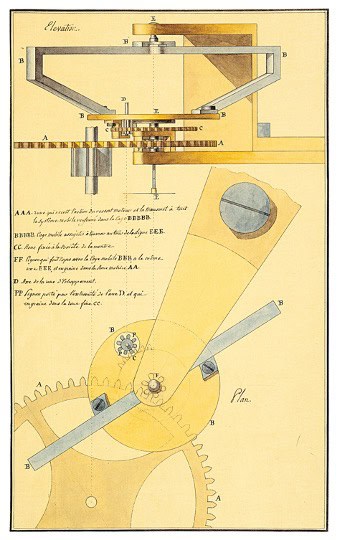
Yet it is for one invention above all others that Abraham-Louis Breguet is remembered. In 1801 he secured a patent for the tourbillon (below), a mechanism conceived to counteract the effects of gravity on a watch’s regulating organ. By mounting the escapement and balance wheel within a rotating cage, positional errors could be averaged out, improving accuracy in pocket watches that spent much of their lives hanging vertically in waistcoat pockets. The tourbillon remains one of the most celebrated achievements in the history of horology and continues to represent the highest levels of watchmaking craftsmanship.
Among Breguet’s most commercially significant creations was the Souscription watch (below), introduced in 1796 during the turbulent years following the French Revolution. Conceived as a robust and relatively affordable precision timepiece, the watch was sold through an innovative subscription model that required customers to pay a quarter of the purchase price in advance. This deposit helped finance production while enabling Breguet to manufacture watches on a larger scale than was customary at the time.
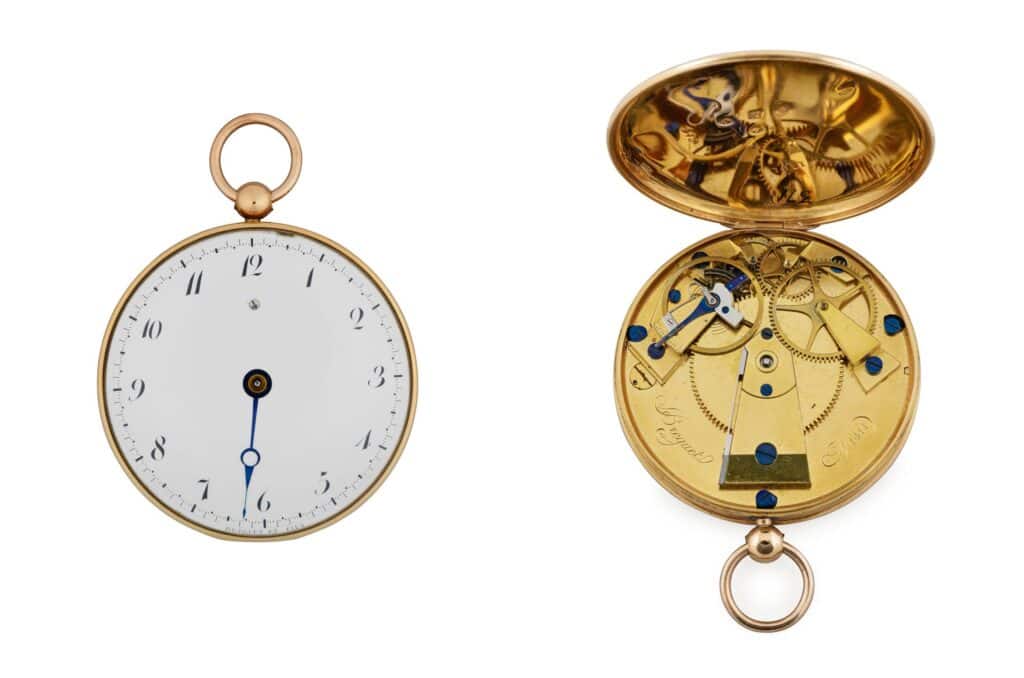
Souscription watch by Abraham-Louis Breguet, 1805, Paris. cience Museum Group/The Clockmakers’ Museum © The Board of Trustees of the Science Museum
Characterised by its clean white enamel dial, prominent single hand and simplified movement architecture, the Souscription watch embodied Breguet’s belief that elegance should be matched by practicality and reliability. More than a commercial success, it represented an early example of modern production methods and demonstrated the master’s ability to combine entrepreneurial ingenuity with horological excellence.
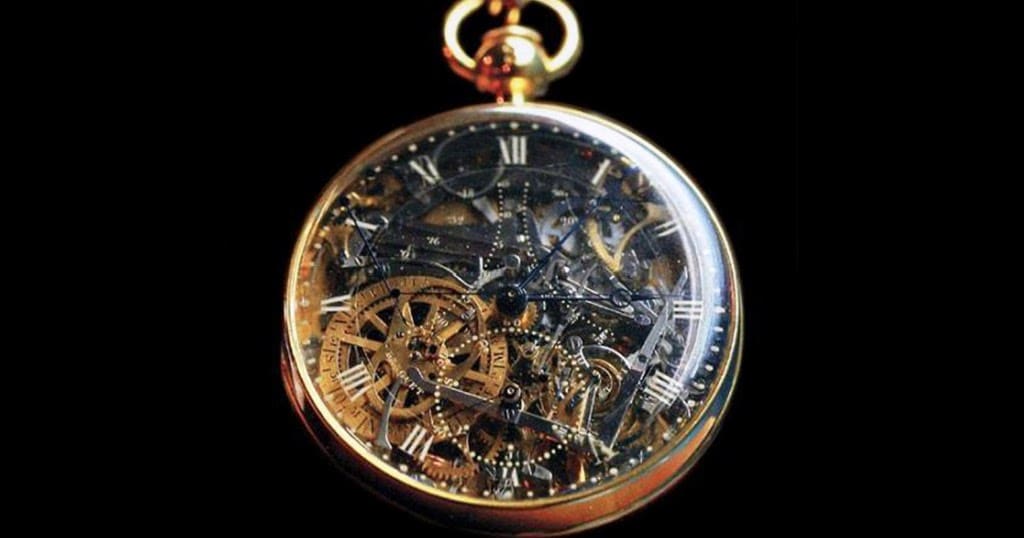
Breguet’s workshop also produced some of the most extraordinary commissions ever undertaken. None is more famous than the legendary No. 160, known as the “Marie-Antoinette” (below). Ordered in 1783 and intended to incorporate every known complication of the era, the watch required decades of work and was completed long after both its royal patron and Breguet himself had died. It remains one of the most iconic timepieces ever created and a symbol of horological ambition without compromise.
The French Revolution forced Breguet to temporarily leave Paris and return to Switzerland, but his reputation survived the political upheaval. Upon his return, his influence grew further. Napoleon Bonaparte became a customer. European royalty sought his creations. In 1815 he was appointed official chronometer maker to the French Navy, a role that reflected his mastery of precision timekeeping. A year later he was elected to the French Academy of Sciences, a rare honour for a watchmaker and recognition of his contribution to applied science.
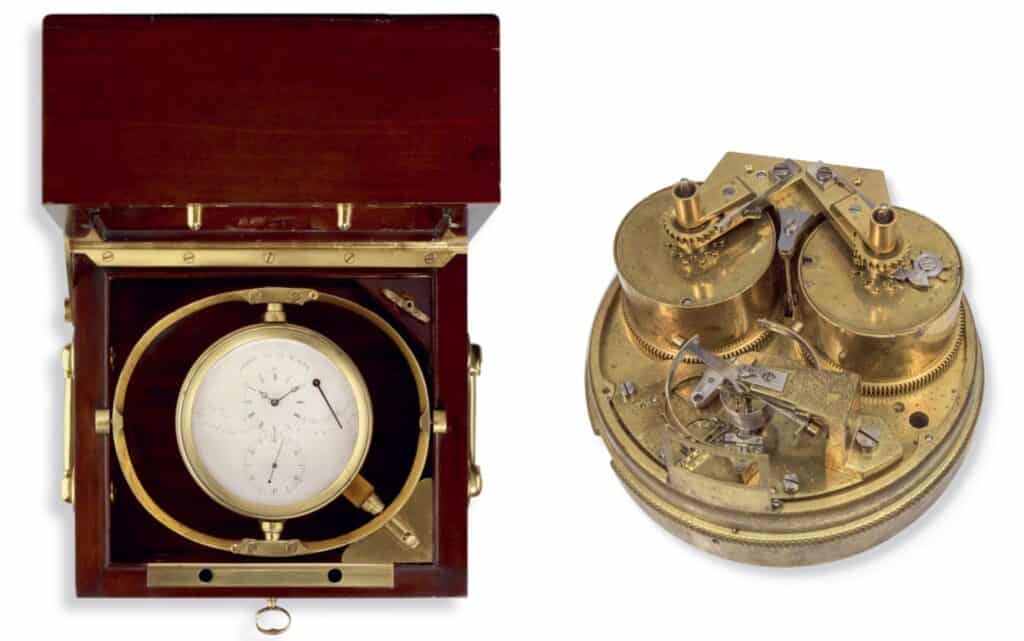
Following his death in 1823, the firm continued under the name Breguet et Fils, with his son Antoine-Louis Breguet carrying forward the family’s reputation for technical excellence. Building on Abraham-Louis’ expertise in precision timekeeping, the company became an important supplier of marine chronometers to navies and merchant fleets during the nineteenth century. These highly accurate instruments played a vital role in celestial navigation, enabling mariners to determine longitude with confidence on long ocean voyages.
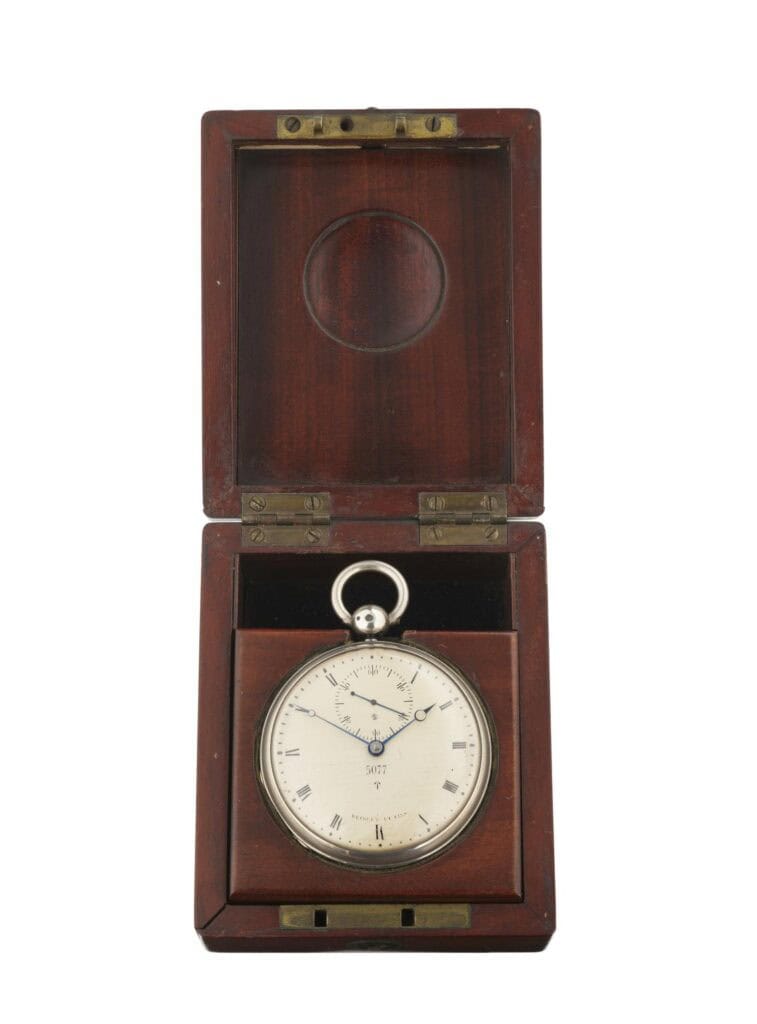
Alongside marine chronometers, Breguet et Fils also produced deck watches (above) and other navigational timekeepers, reinforcing their standing as a leading authority in scientific and maritime horology. In many respects, the firm’s success at sea represented a continuation of Abraham-Louis Breguet’s lifelong pursuit of accuracy, reliability and practical innovation.
What distinguished Breguet from many of his contemporaries was the breadth of his vision. He was not simply creating luxury objects for wealthy patrons. He approached watchmaking as an engineering discipline, continuously refining mechanisms, improving reliability and pushing the boundaries of what portable timekeepers could achieve. Many of the principles he established more than 200 years ago remain fundamental to horology today.
Indeed, modern watchmaking is filled with reminders of his genius. Tourbillons, overcoil balance springs, guilloché dials, shock-protection systems, self-winding mechanisms and even the elegant hands that adorn countless timepieces all owe a debt to Abraham-Louis Breguet. His fingerprints can be found on virtually every chapter of horological development since the late eighteenth century.
While watchmaking has produced many great innovators, few can claim to have reshaped the entire discipline. Harrison solved a problem. Daniels reinvented an escapement. Tompion established standards. Breguet did all these things and more. He transformed watchmaking into both a science and an art.
For that reason, Abraham-Louis Breguet is not merely one of the greatest horologists of his time. He is one of the greatest horologists of all time.
Hero Image: Abraham-Louis Breguet (1747-1823) courtesy of Mounters Breguet